

If you’ve ever stared at a car insurance policy wondering what “excess” actually means for your wallet, you’re not alone. Car insurance excess is the fixed amount you agree to pay out-of-pocket before your insurer steps in to cover the remaining cost of a claim. It’s one of the most important numbers on your policy — and one of the least understood.
The core trade-off is straightforward: a higher excess lowers your annual premium, but it increases the amount you’re personally on the hook for when something goes wrong. Get that balance wrong, and you could find yourself unable to afford a claim — or overpaying for cover you don’t need.
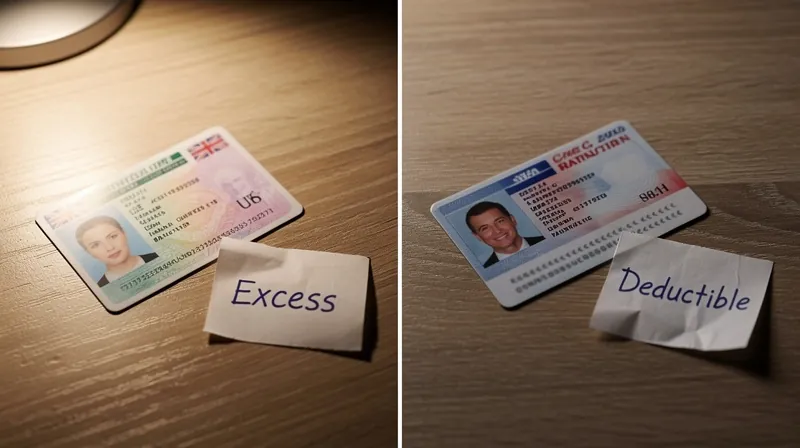
One source of widespread confusion is terminology. In the UK and Australia, this concept is called “excess.” In the United States, the exact same mechanism is called a “deductible.” If you’ve landed here searching for one term and found the other, rest assured — they work the same way.
Your total excess is made up of two components: a compulsory excess set by your insurer, and a voluntary excess that you choose. Together, they determine what you pay every time you make a claim. And that figure should shape one of the smartest decisions any driver can make: whether to claim at all, or simply pay for minor repairs yourself to protect your No Claims Discount.
Key Takeaways
- Excess is a shared risk mechanism: you pay the first portion of any claim, and your insurer pays the rest.
- Your total excess is the sum of your compulsory (insurer-set) excess and your voluntary (self-chosen) excess.
- Raising your voluntary excess can reduce your annual car insurance premium by 10–30%, depending on your policy.
- Even in non-fault accidents, you may need to pay your excess upfront and claim it back from the at-fault driver’s insurer later.
- Claiming for damage below your excess amount is rarely worthwhile — the resulting premium increase will often cost more than the repair itself.
- Your ideal excess level depends on your emergency savings, your driving history, and how confident you are behind the wheel.
What is Car Insurance Excess? (And Why It Matters)
Car insurance excess is the portion of any claim you agree to pay yourself. If your car sustains £800 worth of damage and your total excess is £300, your insurer pays £500 and you pay £300. It’s that simple — but the implications for your premiums, your claims strategy, and your financial safety net are anything but.
Insurers use excess as a “skin in the game” mechanism. When you have a financial stake in every claim, you’re less likely to make small, frivolous ones. This reduces the insurer’s administrative costs and overall risk exposure, which is why they reward higher excess choices with lower premiums.
Think of it this way: your insurer is essentially asking, “How much of this risk do you want to share with us?” The more you’re willing to absorb, the cheaper your annual policy becomes. The less you’re willing to absorb, the more the insurer charges to carry that extra risk on your behalf.
Excess vs. Deductible: UK vs. US Terminology
The terms “excess” and “deductible” refer to the identical concept — the only difference is geography. “Excess” is the standard term used in the United Kingdom and Australia, while “deductible” is universally used across the United States and Canada. The mechanics, calculations, and trade-offs are exactly the same regardless of which word your policy uses.
This terminology gap causes genuine confusion for international drivers, expats, and anyone comparing policies across borders. If you’re reading a US-based insurance guide while searching for “car insurance excess,” the advice still applies directly to your situation. The numbers work identically.
- UK/Australia: “Your policy has a £250 excess.”
- US/Canada: “Your policy has a $250 deductible.”
- Meaning in both cases: You pay the first £250/$250 of any claim.
The Two Types of Excess: Compulsory and Voluntary

Every car insurance policy contains two distinct layers of excess: a compulsory element set by your insurer, and a voluntary element chosen by you. These two amounts combine to form your total excess — the figure that matters when you actually make a claim. Understanding how each layer works gives you real control over your insurance costs.
Compulsory Excess: The Baseline
Compulsory excess is the minimum amount your insurer requires you to pay on any claim — it is non-negotiable and set entirely by the insurer. It reflects how risky the insurer considers you and your vehicle to be, based on statistical data about your driver profile and the car you drive.
Several factors drive this figure up or down:
- Young or inexperienced drivers typically face compulsory excess of £500–£1,000 or more, because insurers view them as statistically higher risk.
- High-performance or luxury vehicles attract higher compulsory excess due to expensive repair costs.
- Drivers with recent claims or convictions may see elevated compulsory amounts at renewal.
- For experienced drivers with clean records and standard vehicles, compulsory excess often ranges from £100 to £300.
You cannot negotiate your compulsory excess directly. However, you can shop around — different insurers assess risk differently, and one insurer’s compulsory excess for your profile may be meaningfully lower than another’s.
Voluntary Excess: The Adjustable Risk
Voluntary excess is the additional amount you agree to pay on top of your compulsory excess, in exchange for a lower annual premium. Unlike compulsory excess, this is entirely your choice — you set it when you buy or renew your policy, typically anywhere from £0 to £500 or more.
The relationship is direct and predictable: every pound you add to your voluntary excess reduces your premium. Insurers calculate this using actuarial models, but the practical result is a meaningful discount on your yearly bill.
The critical question is whether the premium saving is worth the increased financial exposure per claim. This decision should never be made emotionally — it requires a clear-eyed look at your savings buffer and your realistic likelihood of making a claim.
Total Excess: How the Numbers Add Up
Your total excess is simply your compulsory excess plus your voluntary excess. This combined figure is what you will actually pay every time you submit a claim. It’s the number you need to keep front of mind when assessing whether making a claim is financially worthwhile.
Here’s a concrete example:
| Excess Type | Amount |
|---|---|
| Compulsory Excess | £150 |
| Voluntary Excess | £300 |
| Total Excess | £450 |
In this scenario, if your car sustains £1,200 in damage, you pay £450 and your insurer pays £750. If the damage is only £380, you pay the full £380 yourself — and your insurer pays nothing. Knowing your total excess is the foundation of every smart claims decision you’ll make.
How Excess Impacts Your Car Insurance Premium

There is a direct, inverse relationship between your excess level and your car insurance premium: the higher your excess, the lower your annual cost. This isn’t arbitrary — insurers price risk, and a higher excess transfers more financial risk onto you, reducing their potential payout exposure on every claim you might make.
The Inverse Relationship Explained
When you increase your voluntary excess, you signal to your insurer that you’ll absorb a larger share of any loss yourself, making small claims financially irrational for you to submit. This reduces the insurer’s expected claims frequency and payout volume, and they pass that saving back to you through lower premiums.
Typical savings benchmarks to consider:
- Increasing voluntary excess by £100 often saves 10–15% on annual premiums.
- A jump of £200–£300 in voluntary excess can deliver savings of 20–30% or more.
- On a £600 annual premium, a £200 excess increase might save £40–£60 per year.
Over three claim-free years, that £40–£60 annual saving accumulates to £120–£180 — comfortably covering a minor repair you might otherwise have claimed for. This is the mathematical case for higher excess, and it’s compelling for low-risk drivers.
Is a High Excess Right for You?
A high voluntary excess makes financial sense only if you can genuinely afford to pay it immediately without disrupting your finances. Before increasing your excess to chase a premium discount, honestly answer these three questions:
- Do you have an accessible emergency fund? If your total excess would be £500, you need £500 readily available — not locked in savings, not borrowed. If a claim scenario would cause real financial hardship, a lower excess is the safer choice.
- How do you rate your driving risk? Confident, experienced drivers with long clean records are less likely to claim. For them, the premium savings from high excess outweigh the increased per-claim cost. New drivers or those in high-traffic areas face greater exposure.
- What is your vehicle worth? If your car is worth £3,000, setting a £1,000 voluntary excess means minor to moderate damage will fall entirely within your excess range, effectively making your comprehensive insurance redundant for those scenarios.
The downside of high excess is equally clear: when an accident does happen, your out-of-pocket costs are higher. If you face multiple claims in a short period, those costs stack up rapidly. Balance is everything.
What Happens During a Claim? The Mechanics
When you make a car insurance claim, your excess is deducted from the insurer’s payout — you pay your portion to the repairer, and the insurer covers the rest directly. Understanding the exact flow of money helps you avoid surprises and manage the process with confidence.
Step-by-Step Claim Process
Here’s how a standard car insurance claim works from incident to resolution:
- Report the incident. Contact your insurer promptly and provide all relevant details — the incident, any third parties involved, and the extent of damage. Get a repair estimate from an approved repairer.
- Insurer reviews and approves the claim. Your insurer assesses liability and confirms the repair cost. They calculate the claim payout based on the total repair bill minus your excess.
- Insurer pays the repairer directly. In most cases, your insurer pays the repair shop the approved amount, minus your excess. You don’t receive a cheque — the money goes straight to the garage.
- You pay your excess to the repairer. The garage collects your excess portion directly from you, completing the total payment for the repair work.
In practice, most repairers work seamlessly with insurance companies, and the process is relatively frictionless for standard claims. The critical moment is when the bill arrives — your excess must be paid regardless of fault or circumstance.
Claim Scenarios: When You Pay Less Than the Excess
If the total repair cost is less than your excess, your insurer pays nothing — you cover the entire bill yourself. This is one of the most overlooked dynamics in car insurance, and it has significant implications for how you decide whether to involve your insurer at all.
For example: your total excess is £450 and you sustain a £280 scratch on your bumper. Your insurer’s contribution is £0. You pay £280 — but you’ve also triggered an insurance claim on your record, which could increase your premium at renewal and cost you your No Claims Discount. This is precisely why many experienced drivers choose to self-insure minor repairs.
Special Scenarios: Non-Fault Claims and Strategic Decisions

One of the most persistent misconceptions about car insurance excess is that you don’t pay it if someone else caused the accident. In reality, you often pay your excess upfront even in non-fault claims, then recover it from the at-fault party’s insurer later. This distinction matters enormously for your cash flow and claims strategy.
Paying Excess on Non-Fault Claims
If another driver hits your car and admits fault, you may still need to pay your excess to get repairs started, then claim it back once liability is settled. This surprises many policyholders — but it reflects the reality of how claims are processed before fault is formally determined.
Key points to understand about non-fault excess recovery:
- Reimbursement timeline: Once the at-fault driver’s insurer accepts liability, excess recovery typically takes 14–28 days for straightforward cases.
- Liability disputes extend this: If the at-fault driver contests responsibility, your excess could be held up for weeks or even months while insurers negotiate.
- Your No Claims Discount is usually protected on genuine non-fault claims, though this varies by insurer — always verify with your provider.
- Alternative route: Some drivers choose to claim directly through the at-fault driver’s insurer (a “third-party claim”), which may mean no excess at all — but the process can be slower and less within your control.
Strategic Decision: Self-Insuring vs. Claiming
For minor repairs, paying out-of-pocket rather than making an insurance claim is often the smarter financial decision — particularly when the repair cost is close to or below your total excess. This is the strategy insurers don’t advertise, but experienced drivers use it routinely to protect their No Claims Discount and keep premiums low.
Here’s a decision framework to help you choose:
Claim if: The repair cost significantly exceeds your total excess AND the long-term premium impact is less than the claim value.
Self-insure if: The repair cost is at or below your excess, OR the NCD and premium increase over the next 2–3 years would exceed the claim payout.
Let’s run the numbers on a real scenario:
| Scenario | Repair Cost | Total Excess | Insurer Pays | NCD Impact (Est.) | Smart Choice |
|---|---|---|---|---|---|
| Minor scratch | £200 | £450 | £0 | Potential loss of NCD | Self-insure |
| Bumper damage | £600 | £450 | £150 | £80–£150/yr increase | Self-insure or borderline |
| Collision repair | £2,500 | £450 | £2,050 | Manageable over time | Claim |
Your No Claims Discount can reduce your premium by up to 60–75% after several claim-free years. Protecting it for minor repairs is almost always financially rational. When in doubt, get a repair quote first — then do the maths before you call your insurer.
Factors That Influence Your Excess Amount

Your compulsory excess is calculated by your insurer based on a combination of factors relating to you, your vehicle, and where you live. Understanding these variables explains why two drivers with identical voluntary excess choices can end up with very different total excess amounts — and very different premiums.
Vehicle Value and Type
The type of car you drive has a significant impact on your compulsory excess, primarily because it determines the likely cost of repairs after an accident. Insurers set higher baseline excess amounts for vehicles that are expensive or complex to fix.
- Luxury and high-performance cars (e.g., BMW M-Series, Porsche, high-spec SUVs) typically carry higher compulsory excess due to specialist parts and labour costs.
- Imported vehicles often face elevated excess because parts must be sourced internationally, increasing repair costs and timeframes.
- Electric vehicles are increasingly attracting higher excess as insurers adjust for the cost of battery replacement and specialist EV repair facilities.
- Standard, widely available vehicles — particularly those with low insurance group ratings — generally have lower compulsory excess amounts.
Driver Profile and History
Your personal driving profile is arguably the most influential factor in determining your compulsory excess. Insurers use detailed actuarial data to assess how likely you are to make a claim, and price accordingly.
Key profile factors include:
- Age and experience: Drivers under 25 routinely face compulsory excess of £500–£1,500 due to significantly higher accident rates in this demographic. The same applies to newly qualified drivers of any age.
- Claims history: A recent at-fault claim signals elevated risk. Expect compulsory excess to increase substantially at renewal if you’ve claimed within the past 3–5 years.
- Driving convictions: SP30 speeding points or more serious convictions can push compulsory excess up significantly, as they indicate higher-risk behaviour.
- Years of No Claims: Conversely, a long NCD history can help negotiate better terms and lower baseline excess, as it demonstrates a track record of safe driving.
Location and Policy Type
Where you live and what level of cover you choose both affect the excess structure on your policy. Insurers analyse postcode-level data to assess local risk environments — and the differences can be significant.
- High-theft areas: Urban postcodes with elevated vehicle theft statistics often attract higher compulsory excess on comprehensive policies, particularly for popular car models.
- High-accident density zones: Areas with high traffic volumes or poor road safety records can push base excess levels upward for all drivers, regardless of individual history.
- Policy type matters: Comprehensive policies typically carry structured excess for all claim types, while third-party fire and theft policies may have different — sometimes lower — excess structures, though they provide significantly less cover.
- Named driver policies: The excess applicable may differ based on which named driver was operating the vehicle at the time of the incident, particularly for young drivers added to a parent’s policy.
Frequently Asked Questions
Is it better to have high or low excess?
Neither is universally better — the right choice depends on your financial resilience and driving risk. A high excess lowers your annual premium (often by 10–30%) but increases your out-of-pocket cost per claim. If you have a solid emergency fund, drive safely, and rarely claim, a higher voluntary excess typically saves you money over time. If cash flow is tight or you drive in high-risk conditions, a lower excess provides better financial protection when you need it most.
What does excess of £250 mean?
An excess of £250 means you will pay the first £250 of any insurance claim yourself, and your insurer covers the remaining amount. For example, if your car requires £900 in repairs and you have a £250 excess, your insurer pays £650. If repairs cost less than £250, your insurer pays nothing and you cover the full bill.
What does excess of £1,000 mean?
An excess of £1,000 means you are responsible for the first £1,000 of any claim — a significant out-of-pocket commitment. This level is common for young drivers facing high compulsory excess, or for drivers who have chosen a large voluntary excess to substantially reduce their premium. It effectively means that any claim involving damage below £1,000 provides you with no insurance payout at all.
What does $5,000 excess mean?
A $5,000 excess (or deductible in US terminology) means you pay the first $5,000 of any covered repair or loss before your insurance contributes. This level is most common in commercial vehicle policies, high-value vehicle cover, or situations where a driver has chosen an extremely high deductible to minimise monthly premiums. It requires significant financial reserves and should only be chosen by drivers who can comfortably absorb that cost without hardship.
Do I pay excess if someone hits me?
Yes — in many cases you will still need to pay your excess upfront even if another driver is at fault, then claim it back once liability is confirmed. If you claim through your own insurer, they will typically require your excess before arranging repairs. Once the at-fault driver’s insurer accepts liability, your excess is reimbursed — usually within 14–28 days for straightforward cases, longer if fault is disputed.
Can I reduce my car insurance excess?
You can reduce your voluntary excess at any time by choosing a lower amount when you renew or switch your policy. You cannot directly reduce your compulsory excess, as this is set by the insurer based on your risk profile. However, you can shop around — different insurers assess the same driver differently, and comparing quotes may reveal a policy with a lower compulsory excess. Improving your risk profile over time (building NCD, avoiding convictions) will naturally reduce the compulsory excess insurers quote you.
What happens if I can’t afford the excess?
If you cannot pay your excess, your insurer will not proceed with the claim or release funds to the repairer. This is one of the most important reasons to ensure your voluntary excess is set at a level you can genuinely afford to pay immediately. If you find yourself in this position, contact your insurer — some offer payment plans or may work with you on timing, but this is not guaranteed. It’s a clear sign that your voluntary excess was set too high relative to your financial situation.
Is excess the same as a deductible?
Yes — excess and deductible are two terms for the exact same concept, differing only by regional terminology. “Excess” is used in the UK and Australia; “deductible” is the standard term in the United States and Canada. Both refer to the amount you pay out-of-pocket on a claim before your insurer covers the remainder. Every piece of advice about deductibles applies equally to excess, and vice versa.
Do I pay excess if my car is written off?
Yes — your excess applies even when your car is declared a total loss (written off). In this case, your insurer calculates the market value of your vehicle and deducts your total excess from the settlement amount paid to you. For example, if your car is valued at £6,000 and your total excess is £500, you receive £5,500. This makes it especially important to ensure your excess doesn’t represent a disproportionately large chunk of a lower-value vehicle’s worth.
Can I get my excess back if the claim is successful?
Yes, in non-fault claims you are typically entitled to recover your excess from the at-fault party’s insurer once liability is established. Your own insurer may assist with this recovery process, or you can pursue it independently through the third-party insurer. In at-fault claims where you are responsible for the incident, you do not get your excess back — it is your agreed contribution to the cost of the claim. Some specialist insurance products, known as “excess protection insurance,” can reimburse your excess even in at-fault scenarios for a small additional premium.