

Gap insurance for a car bridges a critical financial gap that most drivers don’t even know exists until it’s too late. When your vehicle is totaled or stolen, your standard auto insurance pays out the car’s Actual Cash Value (ACV) — what the car is worth today, not what you paid for it. If you owe more on your loan than the car is worth, you’re left holding the bill for the difference, with no car and a debt you still have to pay.
The risk is greater than most people realize. Cars lose 20–30% of their value in the first year of ownership alone. Finance a $40,000 vehicle with a small down payment, and within 12 months you could owe $36,000 on a car worth $28,000. That’s an $8,000 exposure — and a single bad day on the road could force you to pay every cent of it out of pocket.
Here’s what makes this topic even more urgent: the most common “protection” offered at the dealership is not the same as true gap insurance. Loan/lease payoff coverage and genuine gap coverage are fundamentally different products, and the distinction could cost you over $1,000 in an already devastating situation. Understanding exactly what you’re buying — and where to buy it — is the difference between real financial protection and a false sense of security.
The good news? You can get real gap coverage for as little as $88 per year through your auto insurer — a fraction of what dealerships charge. But only if you know what to ask for.
Key Takeaways
- True gap insurance pays the full difference between your car’s Actual Cash Value and your loan balance, plus your deductible and associated fees — standard loan/lease payoff coverage does not.
- Standard loan/lease payoff coverage does not cover your deductible, which means you can still face a $1,000+ out-of-pocket bill even after a claim is paid.
- Dealerships mark up gap insurance by 500–1,000%, charging $400–$1,000 upfront versus roughly $88 per year through a standard auto insurer.
- Electric Vehicles depreciate 49% in three years compared to 39% for gas-powered cars, making gap insurance especially critical for new EV buyers.
- Cancel gap insurance once your loan balance drops below your car’s actual cash value — at that point, you’re no longer at risk of negative equity.
What Is Gap Insurance and How Does It Work?
Gap insurance is a policy add-on that covers the difference between a car’s Actual Cash Value and the remaining balance on your auto loan if the vehicle is declared a total loss. Without it, you receive the ACV payout from your standard insurer — minus your deductible — but you remain legally obligated to pay off the full remaining loan balance regardless.
To understand why this matters, consider a straightforward example. You purchase a new car for $38,000 and finance the full amount. Eight months later, the car is totaled in an accident. By then, the car’s ACV has dropped to $30,000. Your standard collision insurance pays out $30,000 (minus your $1,000 deductible), putting $29,000 in your pocket. But you still owe $35,500 on the loan. That leaves a $6,500 gap you must pay out of your own funds — for a car you no longer own.
Gap insurance is specifically designed to activate in exactly this scenario. It covers total losses resulting from accidents, theft, and natural disasters. It does not apply to partial damage, mechanical failures, or cosmetic issues. It is a narrow but enormously important layer of financial protection for anyone who finances a new vehicle.
The “Day 1” Total Loss Scenario
The risk of negative equity begins the moment you drive off the lot. A new car can lose as much as 20% of its value immediately after purchase, simply because it transitions from “new” to “used” in an instant. If you finance 100% of the purchase price — which many buyers do — you are underwater from day one.
If a total loss occurs in the first few weeks after purchase, your insurance payout may barely cover half the remaining loan. This “Day 1” scenario is not hypothetical; it’s the precise situation gap insurance was designed to address. Even a minor collision that results in a total loss declaration can trigger this exposure. Insurers total a vehicle when repair costs exceed a certain percentage of its ACV — sometimes as low as 70–80% — making it entirely possible to walk away from a minor accident owing thousands of dollars on a car that’s been written off.
True Gap vs. Loan/Lease Payoff: The Critical Distinction
Not all gap coverage is the same, and the difference matters enormously. True gap insurance covers both the depreciation shortfall and your insurance deductible. Standard loan/lease payoff coverage — often bundled by lenders or offered by dealers — typically only pays the remaining balance, leaving you responsible for the deductible out of pocket.
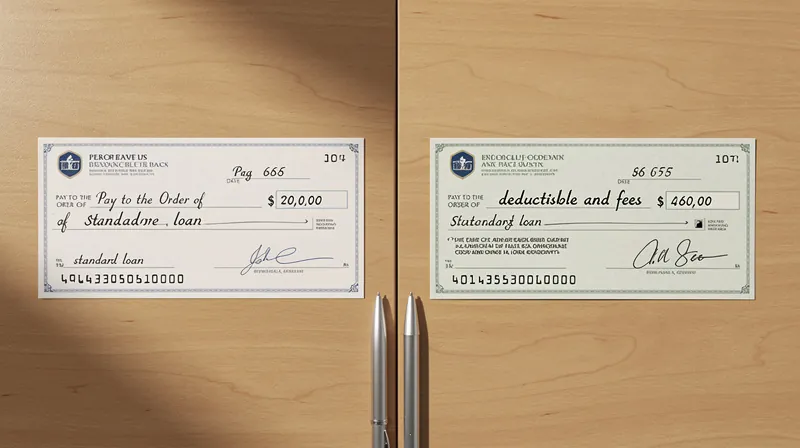
Here’s how that plays out in real numbers. Suppose you owe $30,000 on your car, which has an ACV of $27,000. Your standard insurance pays $27,000 minus your $1,000 deductible, writing you a check for $26,000. Standard loan/lease payoff coverage might bridge the $4,000 gap to pay off the loan — but you’ve still lost $1,000 to your deductible. True gap coverage would have absorbed that $1,000 as well, leaving you with zero out-of-pocket expense.
This is the distinction that most competitors, dealerships, and even some insurance agents gloss over. Buyers assume their “gap coverage” is comprehensive, only to discover after a claim that they’re still writing a four-figure check. Always verify whether a policy explicitly covers your deductible before you purchase it.
Why Lenders Push “Payoff” Coverage
The reason lenders favor loan/lease payoff coverage is straightforward: it protects the lender, not you. If your car is totaled and the insurance payout doesn’t cover the full loan balance, the lender still gets paid in full. The lender’s financial risk is eliminated; yours is not.
Payoff coverage is often promoted as a benefit or even offered for free as part of the loan package. While it’s better than nothing, borrowers should not confuse “the loan gets paid off” with “I have no out-of-pocket costs.” Those are two entirely different outcomes.
The True Gap Advantage
True gap policies function as a secondary insurance layer that sits on top of your primary collision or comprehensive coverage. Beyond covering the deductible, some comprehensive gap policies also include administrative fees, rental car reimbursement, and transfer fees associated with replacing the vehicle.
When comparing policies, look specifically for language that states the policy covers “the difference between the ACV and the outstanding loan or lease balance, including the applicable deductible.” If that language isn’t present, you likely have payoff coverage, not true gap coverage.
The Dealer Markup Exposé: Insurer vs. Dealer Pricing
One of the most financially damaging myths about gap insurance is that it must be purchased at the dealership. It doesn’t. And buying it there costs you significantly more. Dealerships routinely mark up gap insurance premiums by 500% to 1,000% over what you’d pay by adding coverage through your existing auto insurer.
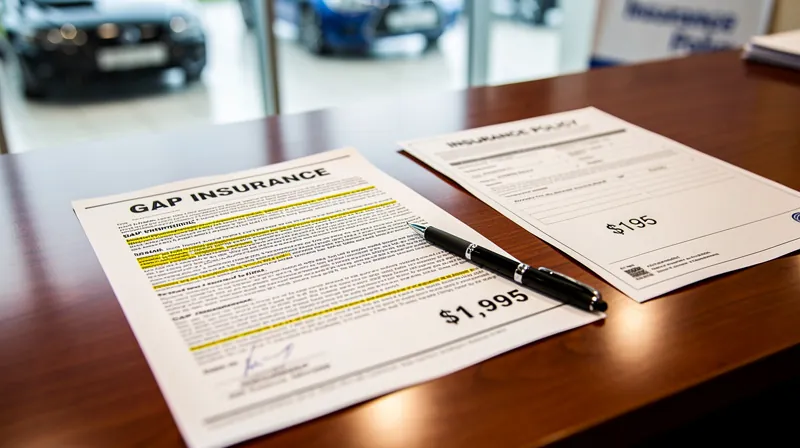
The numbers are stark. Adding gap coverage through a standard auto insurer typically costs an average of $7 to $10 per month — roughly $88 per year. Dealerships, by contrast, charge a lump sum of $400 to $1,000 upfront, often rolled into your loan financing, which means you’re also paying interest on the gap premium itself. Over a five-year loan at a modest interest rate, a $700 dealer gap product can cost you $900 or more in real terms — for a product worth under $90 per year.
This isn’t a minor pricing quirk. It’s a structurally predatory pricing model, and it persists because most buyers don’t know they have alternatives. The finance office at a dealership is a revenue center, and gap insurance is one of its most profitable line items. You are under no obligation to purchase gap coverage from the dealer.
The Cost Breakdown
- Auto insurer add-on: ~$88/year ($7.50/month), added to your existing policy.
- Dealer lump sum: $400–$1,000 upfront, typically financed into the loan.
- Cost of financing the dealer option (5-year loan at 7%): $560–$1,400+ in total payments.
- Markup differential: 500–1,000% more expensive through the dealer.
How to Buy Gap Insurance Correctly
The process of purchasing gap coverage through your insurer is simple and takes less than 15 minutes. Follow these steps:
- Contact your existing auto insurance provider by phone or through their online portal.
- Ask for a quote on a “loan/lease payoff” endorsement — this is the standard terminology most insurers use for gap coverage.
- Verify explicitly that the policy covers your deductible before adding it. Ask: “Does this endorsement cover my deductible in a total loss situation?”
- Confirm the policy is in effect before declining dealer coverage. Do not assume it’s active until you have written confirmation.
You can typically purchase gap coverage from your insurer at any point, not just at the time of purchase. Even if you’ve had the car for a few months and are still in a negative equity position, most insurers will allow you to add the endorsement mid-policy.
Who Needs Gap Insurance? (Eligibility and EV Risks)
Gap insurance is most critical for new car buyers who financed with a low down payment, have a long loan term, or purchased a vehicle with a high depreciation rate. If you put less than 20% down or are financing for more than 60 months, you are almost certainly in a negative equity position for the first several years of ownership.
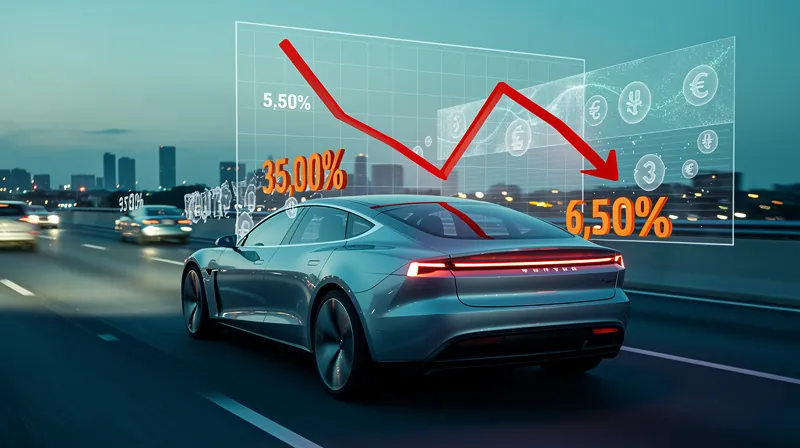
The risk is not uniform across vehicle types. Electric vehicles present a particularly acute gap insurance risk due to their accelerated depreciation. While gas-powered vehicles depreciate an average of 39% over three years, EVs depreciate approximately 49% over the same period. A $50,000 EV that loses half its value in three years creates a far larger potential gap than a comparable gas vehicle — especially for lessees or buyers with minimal down payments.
Used car buyers are generally at lower risk, unless the vehicle is less than three years old or was purchased with very low mileage and near its original MSRP. By the time a car reaches three to four years of age, most of the steep depreciation curve has already played out, reducing — though not eliminating — the gap risk.
The EV Depreciation Trap
The rapid depreciation of EVs is not just a theoretical concern — it’s an ongoing market reality driven by falling battery costs, increasing competition, and frequent price cuts from manufacturers. When a major EV manufacturer cuts the sticker price of a popular model by $5,000–$10,000, every existing owner of that model sees their car’s resale value fall almost immediately.
A $50,000 EV that depreciates 49% over three years is worth approximately $25,500 by year three. If you financed $47,500 of that purchase (5% down), you may still owe $30,000+ on the loan at the three-year mark depending on your term and rate. That’s a potential gap of $4,500 or more — significant enough to cause real financial hardship if a total loss occurs.
For EV buyers especially, gap insurance is not optional protection. It is a fundamental component of responsible vehicle financing.
Lease vs. Own
The gap insurance calculus differs slightly for leased vehicles. Many lease agreements actually require gap insurance to protect the leasing company’s asset — and some lease contracts include it automatically in the monthly payment. Before purchasing additional gap coverage on a leased vehicle, review your lease agreement to confirm whether it’s already included.
For owners (as opposed to lessees), the need for gap insurance is directly tied to the size of the negative equity position. If your loan balance already sits below the car’s current market value, you don’t need gap coverage — and paying for it is wasteful. The moment the loan balance drops below the ACV, gap insurance has done its job and can be cancelled.
Exclusions and Deductible Nuances
Gap insurance is a narrowly defined product with specific exclusions that buyers must understand before assuming they’re fully protected. Gap coverage only activates in a total loss event — a vehicle declared a total loss due to an accident, theft, or natural disaster. It does not cover any other circumstance, no matter how costly.
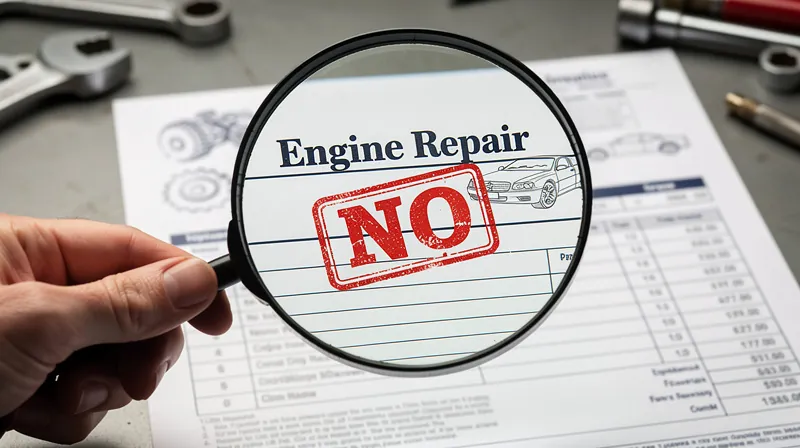
The most common mistake is assuming gap insurance provides broader protection than it does. Buyers who experience a major mechanical failure, a flood-related engine breakdown, or significant cosmetic damage that doesn’t trigger a total loss declaration will receive nothing from their gap policy. The coverage is binary: either the car is a total loss, or gap insurance does not apply.
Understanding the deductible nuance is equally important. Standard gap policies from auto insurers often do not cover your collision or comprehensive deductible — meaning the deductible amount is effectively subtracted from the gap payout. This is the exact scenario where true gap insurance diverges from standard loan/lease payoff coverage, and it’s worth paying close attention to the policy language.
What Is NOT Covered
- Mechanical failure — engine breakdown, transmission failure, or any repair-based issue.
- Routine maintenance — oil changes, tire replacements, brake service.
- Partial damage — repairs to a damaged car that is not totaled do not trigger gap coverage.
- Late fees and penalties — past-due interest, loan penalties, or administrative charges accumulated on the loan are not covered.
- Rollover balances — if you rolled negative equity from a previous vehicle into your current loan, most policies will not cover that rolled-over portion.
Handling the Deductible
The deductible interaction is one of the most misunderstood aspects of gap coverage, and the math can be surprising. Suppose your standard insurance pays $15,000 on a totaled vehicle (ACV of $16,000 minus a $1,000 deductible), and you owe $20,000 on the loan. The gap is $5,000. If your gap policy does not cover the deductible, it will only pay $4,000 of that gap — the $1,000 deductible remains your responsibility.
If your gap policy does cover the deductible, it pays the full $5,000, and you walk away from the total loss with zero out-of-pocket loan obligation. That $1,000 difference might seem small in isolation, but in the context of an already-stressful total loss event, it matters enormously. Always ask your insurer to clarify this specific point before purchasing.
How to Cancel Gap Insurance and Get a Refund
You can cancel gap insurance at any time, as long as you have not already filed a claim under the policy. If you pay off your loan early, sell your vehicle, or trade it in, you are entitled to a pro-rated refund of any unused premium. For dealer-purchased policies, this refund can be several hundred dollars — money most buyers never reclaim because they don’t know to ask.

The right time to cancel is straightforward: when your loan balance drops below the car’s current Actual Cash Value, gap insurance is no longer necessary. You’ve crossed out of negative equity territory, and from that point forward, your standard insurance payout would cover the full remaining loan even without gap coverage. Continuing to pay for gap insurance beyond that point is an unnecessary expense.
For insurer-provided gap coverage, cancellation is typically as simple as calling your agent or logging into your policy portal and removing the endorsement. For dealer-purchased coverage, the process requires a bit more documentation but is equally straightforward.
The Refund Process
- Contact your insurance agent or dealership finance department to initiate the cancellation.
- Provide documentation — typically a loan payoff statement, proof of vehicle sale, or a trade-in confirmation from a dealer.
- Confirm the refund calculation. Refunds are based on the number of unused months remaining in your policy term, calculated on a pro-rated basis.
- Expect processing time of 2–4 weeks for the refund to return to your original payment method or be applied as a credit to your loan.
One important note: if you financed your dealer gap insurance into your auto loan, the refund will typically be applied directly to your remaining loan balance rather than paid out to you as cash. Confirm this with the dealership’s finance office at the time of cancellation to avoid any surprises.
Frequently Asked Questions
What does gap insurance mean for a car?
Gap insurance for a car covers the financial difference between what your insurance company pays (the vehicle’s Actual Cash Value) and what you still owe on your auto loan if the car is totaled or stolen. Because cars depreciate rapidly — sometimes losing 20% of their value in the first year alone — the insurance payout is often less than the remaining loan balance. Gap insurance eliminates that shortfall so you don’t have to pay off a loan on a car you no longer have.
Is gap insurance a good idea?
Gap insurance is a good idea for most new car buyers who finance with less than 20% down, have loan terms longer than 60 months, or purchase an electric vehicle. In these situations, negative equity is almost inevitable in the early years of ownership, and the cost of gap coverage — as low as $88/year through an insurer — is minimal compared to the potential exposure of thousands of dollars in uncovered debt. It becomes unnecessary once your loan balance falls below the car’s market value.
How much does it cost to get gap insurance?
Gap insurance costs approximately $88 per year (about $7.50/month) when purchased as an add-on through your auto insurance provider. Dealerships charge significantly more — typically $400 to $1,000 as an upfront lump sum, often financed into the loan, which adds interest charges on top of the premium. The difference in cost between the two options can exceed $500 to $800 over the life of a typical five-year loan.
Can I purchase gap insurance by itself?
Yes — you can purchase gap insurance as a standalone endorsement through your existing auto insurance provider without buying it from the dealership. Most major auto insurers offer a “loan/lease payoff” endorsement that functions as gap coverage and can be added at any point during the life of your loan, not just at purchase. Some specialized insurers also offer standalone gap policies for situations where your primary insurer doesn’t offer the endorsement.
What does gap insurance not cover?
Gap insurance does not cover mechanical repairs, routine maintenance, cosmetic damage, partial losses, or any event that does not result in the vehicle being declared a total loss. It also typically does not cover late payment fees or interest penalties accrued on the loan, and most standard policies will not cover any negative equity rolled over from a previous vehicle into the current loan. The coverage is strictly limited to the gap between your ACV payout and your remaining loan balance at the time of a total loss.
How do I cancel gap insurance?
To cancel gap insurance, contact your insurer or dealership, provide documentation confirming you’ve paid off the loan or sold the vehicle, and request a pro-rated refund of unused premium. For insurer-provided coverage, this is typically done through a quick phone call or policy portal update. For dealer-purchased coverage, you’ll need to contact the dealership’s finance office directly, and the refund — which can be several hundred dollars — will usually be applied to your remaining loan balance.
Is gap insurance required by law?
No — gap insurance is not required by law in any U.S. state. However, some lenders and leasing companies require it as a condition of financing or the lease agreement, so it may be contractually mandatory even if it isn’t legally required. Always review your loan or lease documents to determine whether gap coverage is a lender requirement before assuming it’s optional.
Do I need gap insurance for a leased car?
Gap insurance is strongly recommended — and often already included — for leased vehicles, because you are responsible for the full residual value of the car if it’s totaled. Many lease agreements bundle gap coverage into the monthly payment to protect the leasing company’s asset. Before purchasing additional coverage, review your lease contract carefully. If gap is not included, add it through your insurer rather than paying the dealer’s inflated rate for an identical product.