
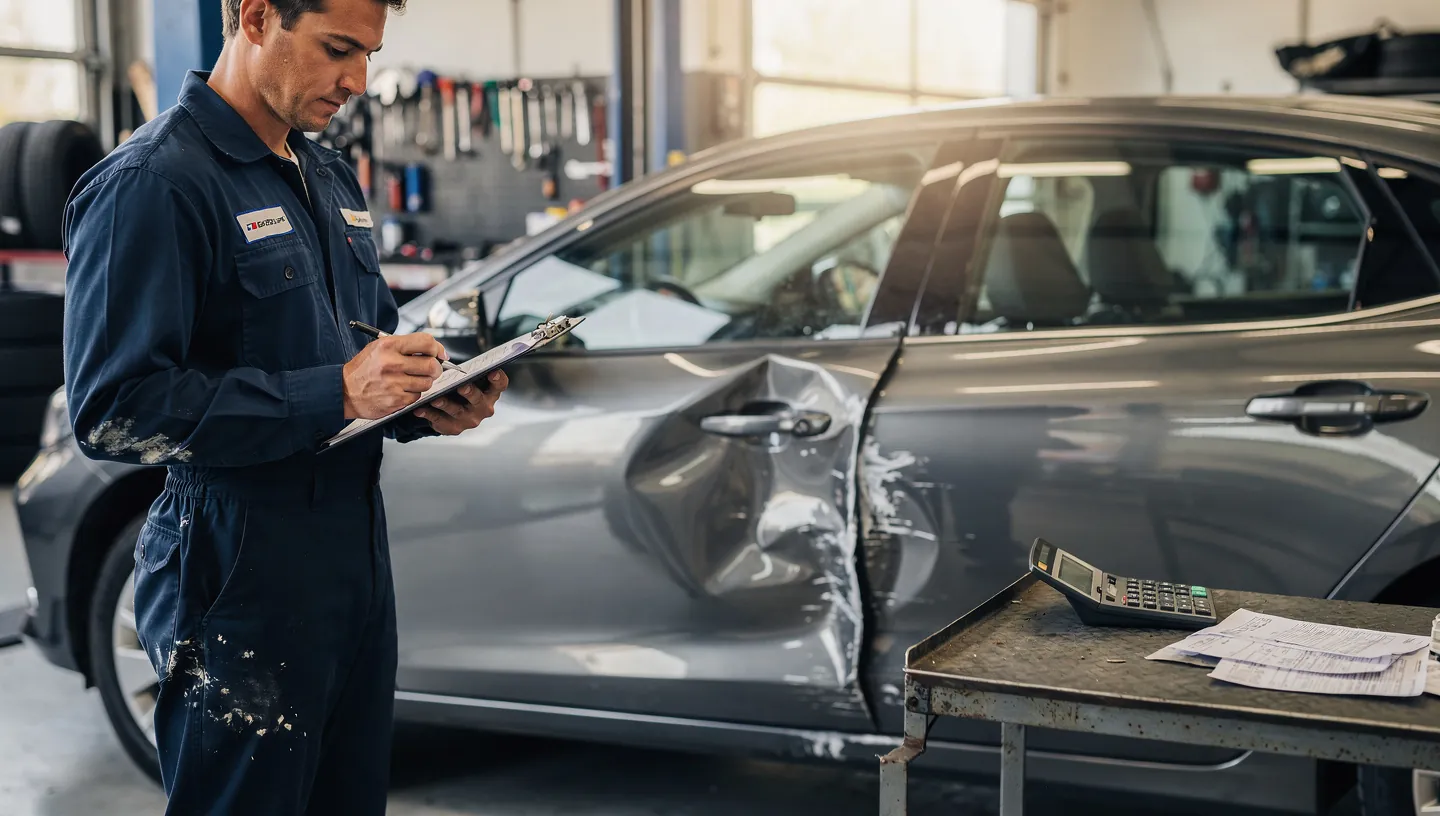
The short answer is: it depends on what type of coverage you have. If you are at fault in a car accident, your liability insurance will not pay to fix your own vehicle — it only covers damage you cause to others. To have your own car repaired after an at-fault accident, you need collision coverage as part of your auto insurance policy. Without it, you pay for your own repairs entirely out of pocket.
Understanding this distinction is critical, especially when you’re standing at the side of the road, adrenaline still running, wondering what happens next. Your deductible — typically ranging from $500 to $2,000 — will be subtracted from whatever your insurer pays toward repairs. So even with collision coverage, you bear some of the cost yourself.
Fault is rarely black and white. Insurance companies investigate accidents using police reports, traffic laws, witness statements, and increasingly, AI-powered analysis tools. In states like California, which follows a pure comparative negligence standard, fault can be split between both parties — meaning even if you’re 30% responsible, the other driver’s insurer may owe you 70% of your damages. California also sets minimum liability limits at 30/60/15 (meaning $30,000 per person, $60,000 per accident in bodily injury, and $15,000 in property damage liability), which may not be enough to cover modern repair costs.
This guide walks you through every stage of the process — from the moment of impact to the final repair bill — so you know exactly where you stand, what your policy covers, and how to protect your financial interests every step of the way.
Key Takeaways
- Liability insurance does not pay for repairs to your own vehicle after an at-fault accident — it only covers the other party.
- You need collision coverage on your policy to fix your own car, and you will still pay your deductible first.
- Filing a claim will likely increase your future insurance premiums, sometimes by 20–50% depending on your insurer and state.
- Insurance companies determine fault based on evidence including police reports, traffic laws, camera footage, and witness accounts.
- Rental car reimbursement is an optional add-on but is highly recommended — without it, you pay for a rental yourself during repairs.
- Never admit fault at the scene — doing so can jeopardize your claim and expose you to greater legal liability.
- In pure comparative negligence states like California, you can be 1% at fault and still recover 99% of your damages from the other party.
The Short Answer: Does Insurance Fix Your Car if You Are at Fault?
No — liability insurance does not fix your car if you are at fault. Liability coverage is legally required in most states precisely because it protects other people from your mistakes. If you want your own vehicle repaired after an accident you caused, you must have collision coverage — a separate, optional component of your auto insurance policy.
The U.S. auto insurance system is largely built around an at-fault model: whoever caused the accident is financially responsible for the resulting damage. If you rear-ended someone, your liability insurance pays for their repairs and medical bills. But your car? That’s your problem — unless you’ve purchased collision coverage in advance.
Liability Insurance: What It Actually Covers
Liability insurance covers bodily injury and property damage that you cause to others — not yourself or your vehicle. It pays for the other driver’s car repairs, their medical expenses, and in some cases, legal fees if they sue you.
- Bodily Injury Liability (BI): Pays for injuries to the other driver and their passengers.
- Property Damage Liability (PD): Pays to repair or replace the other driver’s vehicle or property.
- Mandatory in nearly every state: California’s minimum is 30/60/15, but many newer vehicles — especially EVs — cost far more than $15,000 to repair.
Here’s the critical limitation: those minimum limits can be exhausted quickly. A single serious accident can generate repair bills and medical expenses that far exceed state-mandated minimums, leaving you personally liable for the remainder.
Collision Coverage: Fixing Your Own Vehicle
Collision coverage pays to repair or replace your own vehicle after an accident, regardless of who is at fault. It’s optional but essential if you want financial protection for your own car. Lenders and leasing companies typically require it if you’re financing or leasing a vehicle.
- How it works: After an at-fault accident, you file a collision claim. Your insurer pays the repair cost minus your deductible.
- Deductible range: Most collision deductibles fall between $500 and $2,000. A higher deductible means lower monthly premiums but more out-of-pocket expense at claim time.
- Expert recommendation: Financial advisors consistently recommend “full coverage” (liability + collision + comprehensive) for any vehicle worth more than $5,000.
It’s also worth noting that comprehensive coverage is different — it covers non-collision events like theft, hail, flood, or fire. Neither comprehensive nor liability coverage will pay for crash damage to your own car. Only collision does.
Understanding Deductibles and Out-of-Pocket Costs

A deductible is the portion of a repair bill you pay before your insurance kicks in. If your car sustains $4,000 in damage and your deductible is $1,000, your insurer pays $3,000 and you pay $1,000. The real financial question isn’t just what you owe now — it’s whether filing a claim will cost you more in premium increases over the long run.
How Deductibles Work in At-Fault Claims
When you file a collision claim after an at-fault accident, your deductible is subtracted directly from the repair payout. Your insurer does not reimburse the deductible — it simply determines your net benefit.
- Typical deductible range: $250, $500, $1,000, or $2,000 — you choose when you purchase your policy.
- Higher deductible = lower premium: Raising your deductible from $500 to $1,000 can reduce annual premiums by 10–15%.
- When to skip filing: If your repair cost is only slightly above your deductible, you may be better off paying out-of-pocket and avoiding a claim-related premium increase.
Financial Breakdown: Repair Costs vs. Deductible
The decision of whether to file a claim or pay out-of-pocket is one of the most consequential financial choices after a minor at-fault accident. Always run the numbers before calling your insurer.
Consider this real-world scenario:
- Repair cost: $2,500
- Your deductible: $1,000
- Insurance payout: $1,500
- Estimated annual premium increase (3 years): $400–$600/year = $1,200–$1,800 total
In this scenario, filing the claim to save $1,500 today could cost you $1,800 in additional premiums over three years — a net loss of up to $300. For minor accidents, paying out-of-pocket can be the smarter long-term financial move.
Average car repair costs vary widely by accident type: a minor fender bender might run $500–$1,500, while a moderate collision with airbag deployment can easily exceed $8,000–$15,000. At those higher figures, filing a claim almost always makes financial sense despite the premium impact.
Step-by-Step Claims Workflow: What to Do After an Accident
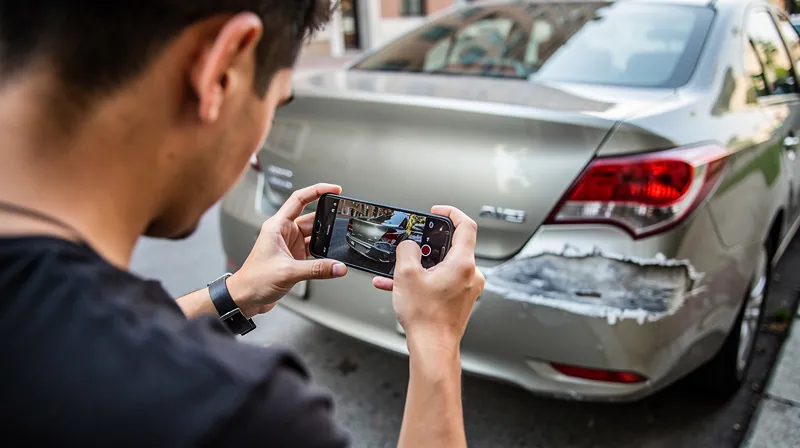
After an at-fault accident, the steps you take in the first 30 minutes are the most important for protecting your claim. Most people are in shock — but a clear, documented account of events can be the difference between a smooth claim and a protracted dispute. Here is the exact workflow to follow, from moment of impact to repair completion.
This is one area where most guides fall short. They tell you what coverage to buy but not exactly what to do after the crash. Follow these steps in order.
Immediate Actions: Documentation and Reporting
Step 1: Ensure safety first. Move vehicles out of traffic if possible and check for injuries. Call 911 immediately if anyone is hurt.
Step 2: Document everything at the scene.
- Photograph all vehicle damage from multiple angles, including close-ups and wide shots.
- Capture license plates, the surrounding scene, skid marks, traffic signs, and road conditions.
- Take photos of the other driver’s license, insurance card, and vehicle registration.
- Note the time, date, weather, and exact location.
Step 3: Exchange information. Get the other driver’s full name, phone number, insurance company, policy number, and vehicle information (make, model, year, plate).
Step 4: File a police report. Even for minor accidents, a police report is a critical piece of evidence. In California, if an accident results in injury or property damage exceeding $1,000, you are legally required to file a DMV SR-1 form within 10 days. Many other states have similar requirements.
Step 5: Notify your insurer promptly. Call your insurance company as soon as possible — most require timely reporting. Do not delay, as late reporting can be grounds for claim denial.
Working with the Insurance Adjuster
An insurance adjuster is assigned to investigate your claim, assess damage, and determine fault. They work for the insurer — not for you — so how you communicate matters significantly.
- Be factual, not speculative. Describe what happened based on what you observed. Say “I didn’t see the other car” rather than “I ran the light.” Never guess or offer opinions about fault.
- Do not admit liability. Even saying “I’m sorry” can be used to assign fault. Let the investigation determine responsibility.
- Request everything in writing. Get repair estimates, coverage explanations, and settlement offers documented.
When it comes to repairs, you have options. Your insurer may offer a direct repair program (DRP) — a network of pre-approved shops that have agreements with your insurer to streamline estimates and repairs. These shops are convenient, but you are legally entitled to choose your own repair facility in most states. If you have a preferred mechanic or dealer, use them.
The Impact on Your Insurance Premiums

Filing an at-fault collision claim will almost certainly raise your insurance premiums. The increase varies by state, insurer, your prior record, and the severity of the accident — but first-time at-fault accidents typically increase premiums by 20% to 50%. In some cases, high-risk drivers see increases of 80% or more.
How Much Will My Rates Rise?
Several factors determine how sharply your insurance premium increase hits after an at-fault claim:
- Your driving history: A clean record before the accident results in a smaller hike than if you have prior violations.
- Severity of the accident: A minor fender bender raises rates less than an accident with injuries or total losses.
- Your insurer’s pricing model: Some carriers are more aggressive with surcharges than others.
- State regulations: Some states cap how much insurers can raise rates after a single incident.
The surcharge period typically lasts three to five years, meaning you’ll pay elevated premiums throughout that window. A 30% rate increase on a $1,800/year policy adds $540 annually — or $1,620 over three years.
Premium Hikes vs. Deductibles: Which Is Worse?
Over the long term, the cumulative cost of a premium increase often far exceeds the deductible you would have paid at the time of the accident. This is the central financial calculus every driver should understand.
- Accident forgiveness programs: Many major insurers offer a first-accident forgiveness clause, either automatically after a period of clean driving or as a purchasable add-on. If you have this, a single at-fault claim may not raise your rate at all.
- Good driver discounts: Filing a claim can eliminate these discounts, effectively doubling the financial penalty.
- Shopping your policy: After a claim, compare quotes from multiple carriers. Rates vary enormously — switching insurers can offset much of the surcharge from your current provider.
Deep Dive: Fault Determination and Comparative Negligence

Fault determination is the process by which insurance companies — and courts — decide who is legally and financially responsible for an accident. This process draws on multiple data sources and is rarely instantaneous. Understanding how it works helps you protect your rights throughout the claims process.
How Insurance Companies Investigate Fault
When both parties submit claims, insurance adjusters conduct parallel investigations to reconstruct what happened. The tools and evidence they use include:
- Police reports: The officer’s written account, diagram, and any citations issued carry significant weight.
- Witness statements: Independent witnesses who have no stake in the outcome are highly credible.
- Traffic camera footage: More intersections are covered than ever before, and adjusters routinely request this footage.
- Dashcam video: If either party has a dashcam, its footage can definitively resolve disputes.
- AI and telematics data: Insurers increasingly use AI algorithms and data from connected vehicles (speed, braking, steering inputs) to reconstruct accidents with mathematical precision.
- Traffic law analysis: Right-of-way laws, speed limits, and traffic controls are cross-referenced against physical evidence.
“He said, she said” situations — where there are no witnesses, no cameras, and conflicting stories — are among the most challenging cases. In these scenarios, adjusters assess physical evidence (impact angles, debris location, damage patterns) to make a probabilistic determination.
Pure Comparative Negligence Explained
Pure comparative negligence is a legal doctrine that allows fault to be apportioned between multiple parties, with each paying damages proportional to their share of responsibility. California is one of several states that follows this model.
Here’s how it works in practice:
- You are 20% at fault for an accident (perhaps you were slightly speeding).
- The other driver is 80% at fault (they ran a red light).
- Your total damages are $10,000. You can recover $8,000 (80%) from the other driver’s insurer.
- The other driver can theoretically recover 20% of their damages from you.
This is critically different from contributory negligence states, where being even 1% at fault can bar you from any recovery. Under pure comparative negligence, you can be 99% at fault and still recover 1% of your damages — though the practical value is minimal at that point.
Know your state’s standard. Some states use modified comparative negligence, where recovery is only possible if your fault is below a threshold (typically 50% or 51%). This can dramatically affect your claim outcome.
Rental Car Reimbursement and Convenience
Rental car reimbursement coverage pays for a temporary vehicle while your car is being repaired — but only if you’ve added it to your policy. Without this optional add-on, you’re responsible for rental costs entirely on your own. Given that even minor repairs can take one to two weeks, this can add up to $400–$700 or more out-of-pocket.
Availability of Rental Coverage
Rental reimbursement is typically sold as an inexpensive policy endorsement — often just $5–$15 per month — making it one of the best value add-ons available in auto insurance.
- Standard daily limits: Most policies cover $30–$50 per day for the rental, with a maximum benefit period (often 30 days).
- Choosing a vehicle: Your daily limit determines what class of rental you can afford without paying the difference. Economy and compact cars typically fall within standard limits; SUVs and luxury vehicles may not.
- At-fault vs. not-at-fault: If the other driver is at fault, their liability insurance (specifically their property damage liability) should cover your rental. If you are at fault, you rely on your own rental reimbursement coverage.
- Timing: Coverage typically begins when your vehicle is declared in need of repair and ends when repairs are complete or the coverage limit is reached — whichever comes first.
If you don’t have rental coverage and you are at fault, consider whether your credit card offers rental car reimbursement — some premium credit cards include this benefit for rentals charged to the card.
Special Considerations: Uninsured Motorists and EVs

Two growing challenges in auto insurance deserve special attention: the prevalence of uninsured drivers and the uniquely high repair costs of electric vehicles. Both scenarios can leave even well-insured drivers financially exposed if they haven’t planned appropriately.
What If the Other Driver Has No Insurance?
Uninsured motorist (UM) coverage protects you when the at-fault driver has no insurance — or not enough insurance — to cover your damages. According to the Insurance Research Council, roughly 1 in 8 drivers on U.S. roads is uninsured. In some states, that figure exceeds 20%.
- UM/UIM property damage: Covers your vehicle repairs when the other driver is at fault but uninsured or underinsured.
- UM bodily injury: Covers your medical expenses and lost wages in the same scenario.
- Without UM coverage: Your only recourse against an uninsured driver is a lawsuit — and if they have no assets, collecting a judgment is nearly impossible.
- Subrogation: If your insurer pays your claim and later pursues the uninsured driver for reimbursement, this is called subrogation. You generally do not have to take action yourself — your insurer handles it.
Some states require insurers to offer UM/UIM coverage; others allow you to waive it. Do not waive it. The premium cost is minimal relative to the protection it provides.
Repair Costs for Electric Vehicles
Electric vehicles cost significantly more to repair than comparable gasoline-powered cars — a reality that has caught many EV owners off guard when filing claims. The implications for insurance are profound.
- Battery damage: EV battery packs can cost $10,000 to $30,000 or more to replace. Even minor rear-end collisions can trigger battery replacement if sensors detect any compromise to the pack’s structural integrity.
- Specialized parts and labor: EV repairs require certified technicians and brand-specific parts, which are less widely available than standard components. This extends repair timelines and inflates costs.
- Impact on liability limits: California’s minimum property damage liability of $15,000 is almost certainly insufficient to cover a totaled or severely damaged EV. If you cause an accident involving a Tesla, Rivian, or similar vehicle, you could personally owe tens of thousands above your liability limit.
- Recommendation: EV owners and anyone who may be involved in an accident with an EV should carry substantially higher property damage liability limits — $50,000 to $100,000 is a more realistic floor for modern traffic conditions.
Frequently Asked Questions
Will my insurance pay if it was my fault?
Yes — but only if you have the right type of coverage. Your liability insurance will not pay for your own car; it covers the other driver’s vehicle and injuries. If you have collision coverage, your insurer will pay to repair your vehicle minus your deductible, regardless of fault. Without collision coverage, you must pay for your own repairs entirely.
Will insurance pay out if it’s my fault?
Your insurer will pay out for damages you caused to others through your liability coverage, and it will pay for your own car repairs through your collision coverage. The key is having the right coverage in place before the accident. Always verify your policy includes collision coverage if you want protection for your own vehicle.
Why should you never admit fault?
Admitting fault — even casually — can be used as a legal admission against you, potentially increasing your financial liability beyond what your insurance covers. Fault determination is a technical and legal process best left to insurers, police, and attorneys. Saying “I’m sorry” at the scene might feel natural, but it can be interpreted as an acknowledgment of responsibility in a later legal proceeding.
What not to say to the insurance adjuster?
Never speculate about fault, exaggerate or minimize injuries, or give recorded statements without understanding your rights. Avoid phrases like “I think I was going too fast,” “I didn’t see them,” or “I’m fine” (if you are unsure about injuries). Stick to factual, observable information and consult an attorney before giving a recorded statement if the accident is serious.
Do I have to pay my deductible if I’m at fault?
Yes — if you file a collision claim for your own vehicle after an at-fault accident, you must pay your deductible. Your insurer pays the repair cost above that amount. The deductible is always your responsibility when you are at fault, because there is no other party’s insurer to recover it from.
How does insurance determine fault in a car accident?
Insurers determine fault by reviewing police reports, witness statements, traffic laws, photos, camera footage, and physical evidence from the accident scene. Increasingly, AI tools and telematics data from connected vehicles are used to reconstruct crashes. In disputed cases, both insurers may negotiate a shared-fault determination based on the available evidence.
What happens if the other driver’s insurance denies my claim?
If the other driver’s insurer denies your claim, you have several options: file a claim under your own collision coverage, request an independent appraisal, file a complaint with your state’s insurance commissioner, or pursue legal action. Your own insurer may also be able to negotiate with the other carrier through subrogation. Consult a personal injury attorney if the denial involves significant damages.
Is collision coverage worth it?
Collision coverage is generally worth it if your vehicle is worth more than $5,000, you couldn’t easily afford to replace it out-of-pocket, or you drive frequently in high-traffic conditions. As a vehicle ages and depreciates, the cost-benefit calculus shifts — when annual premiums approach 10% of the car’s actual cash value, dropping collision may be financially justified. Always compare your vehicle’s value against your annual premium plus deductible before deciding.
Does my insurance go up if I file a claim?
Yes — filing an at-fault claim typically raises your premiums by 20% to 50% for three to five years. Not-at-fault claims may also affect rates with some insurers, though most states limit or prohibit surcharges for not-at-fault accidents. If your insurer offers accident forgiveness, your first at-fault incident may not trigger a rate increase at all.