
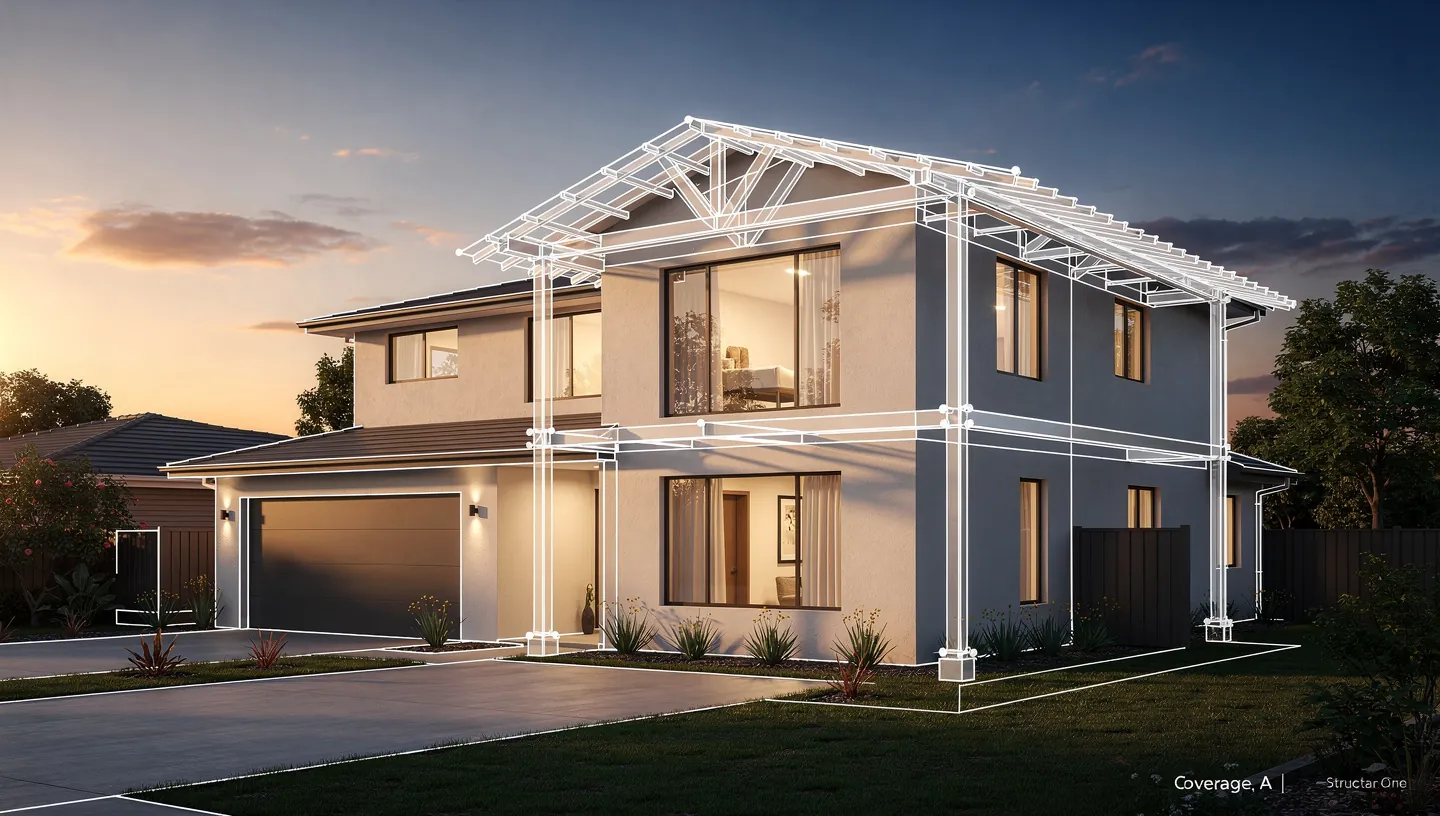
Dwelling coverage, also known as Coverage A, is the foundation of your homeowners insurance policy. When a fire tears through your kitchen, a windstorm peels off your roof, or a falling tree collapses your living room, it’s Coverage A that pays to repair or rebuild the physical structure of your home — so you’re not left absorbing a catastrophic financial loss alone.
Here’s where most homeowners go wrong: dwelling coverage is not based on your home’s market value. Insuring your house for what you paid — or what Zillow says it’s worth today — can leave you dangerously underinsured when disaster strikes. The number that matters is the cost to rebuild, which in 2026 is frequently higher than the purchase price, particularly in high-demand or disaster-prone markets.
This guide covers exactly what Coverage A protects, what it excludes, how to calculate the right limit using a concrete formula, and why inflation trends make an annual policy review essential in today’s market.
Key Takeaways
- Dwelling coverage (Coverage A) pays to repair or rebuild your home’s physical structure — not the land beneath it.
- It covers attached structures like garages and decks, but excludes detached sheds and fences, which fall under Coverage B.
- Most standard HO-3 policies are open-peril for the dwelling, covering all risks except those explicitly excluded.
- Floods and earthquakes are almost always excluded and require separate policies.
- The correct coverage limit is calculated as square footage × local rebuild cost per square foot — not your home’s purchase price.
- Construction costs have risen 30–40% since 2019, making annual policy reviews essential to avoid underinsurance.
What Is Dwelling Coverage? (Coverage A Explained)
Dwelling coverage is the portion of your homeowners insurance policy that pays to repair or rebuild the physical structure of your home when it’s damaged or destroyed by a covered peril. It protects the walls, roof, floors, foundation, and permanently installed fixtures — essentially everything that constitutes the home itself, excluding the land it sits on.

The most important concept to understand is the difference between rebuild cost and market value. Market value reflects what a buyer would pay for your home today — factoring in land, neighborhood desirability, and market conditions. Rebuild cost, also called replacement cost, is what a contractor would charge to reconstruct your home from scratch using current labor rates and materials.
These figures are often dramatically different. A home in a desirable urban neighborhood may carry a market value of $600,000 but a rebuild cost of only $350,000, because land — which doesn’t burn down — accounts for a large share of the market price. In regions experiencing labor shortages or post-disaster demand surges, rebuild costs can actually exceed market value.
Coverage A typically accounts for 70–80% of your total homeowners insurance premium, making it the single largest and most consequential component of your policy. Setting this number correctly is the difference between a full financial recovery and a crisis.
Replacement Cost vs. Actual Cash Value
When you establish dwelling coverage, you choose between two valuation methods that determine how much your insurer pays on a claim.
- Replacement Cost Value (RCV): Pays the full cost to repair or rebuild your home with new, like-kind materials at current prices — with no depreciation deducted. If your 15-year-old roof is destroyed, you receive the cost of a brand-new roof at today’s rates.
- Actual Cash Value (ACV): Pays only the depreciated value of the damaged structure at the time of loss. That same 15-year-old roof might be valued at 30–40% of its original cost, leaving you responsible for the balance.
For primary residences, replacement cost value is almost always the better choice. The premium difference is modest relative to the potentially devastating payout gap an ACV policy creates after a major loss. ACV coverage is more common for older homes, investment properties, or cost-sensitive situations — but homeowners should understand exactly what they’re trading away before opting for it.
What Structures Does Dwelling Coverage Protect?
Dwelling coverage protects the main home and anything permanently attached to it — attached garages, decks, porches, built-in appliances, hardwood flooring, cabinetry, and HVAC systems. If it’s bolted, nailed, or built into the home’s structure, it almost certainly falls under Coverage A.
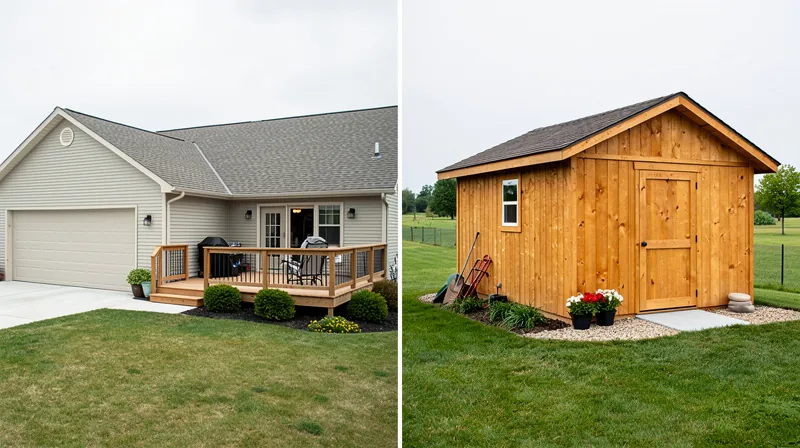
The distinction between Coverage A and Coverage B is straightforward in most cases: attachment to the main home. Here’s how the most common structures are classified:
| Structure | Coverage Type | Notes |
|---|---|---|
| Main home walls, roof, foundation | Coverage A (Dwelling) | Core structural protection |
| Attached garage | Coverage A (Dwelling) | Must be physically connected to the home |
| Attached deck or porch | Coverage A (Dwelling) | Connected to the main structure |
| Built-in appliances and cabinetry | Coverage A (Dwelling) | Permanently installed fixtures |
| Detached garage or shed | Coverage B (Other Structures) | Separate coverage limit applies |
| Freestanding fence | Coverage B (Other Structures) | Not physically attached to the home |
| Detached swimming pool or cabana | Coverage B (Other Structures) | May require additional review for high-value pools |
Dwelling Coverage vs. Other Structures (Coverage B)
Other Structures coverage (Coverage B) automatically defaults to 10% of your Coverage A limit in most standard homeowners policies. If your dwelling is insured for $400,000, you have $40,000 in Coverage B for detached structures — sufficient for most homeowners with a modest shed or fence.
The gap becomes critical when you have high-value detached structures. A detached guest house, for example, can cost $150,000–$250,000 to rebuild. At the standard 10% rule, you’d need a Coverage A limit of $1.5–$2.5 million for Coverage B to keep pace — an unlikely match for most policies. If your property includes a substantial detached structure, discuss raising your Coverage B limit or purchasing separate coverage with your insurer.
What Does Dwelling Coverage Actually Cover? (Covered Perils)
A covered peril is a specific cause of damage that your insurer agrees to pay for under your policy terms. Not every disaster qualifies, and the scope of coverage depends on the type of policy you hold. This distinction is one of the most frequently misunderstood elements of dwelling coverage home insurance.
The two primary policy structures are:
- HO-3 (Open-Peril for Dwelling, Named-Peril for Personal Property): The most common homeowners policy in the U.S. Your dwelling under Coverage A is protected against all perils except those explicitly excluded in the policy. Personal property, however, is only covered for named perils.
- HO-5 (Open-Peril for Both): Both the dwelling and personal property are covered against all risks unless specifically excluded. This provides the broadest standard protection and is typically recommended for high-value homes or those with valuable contents.
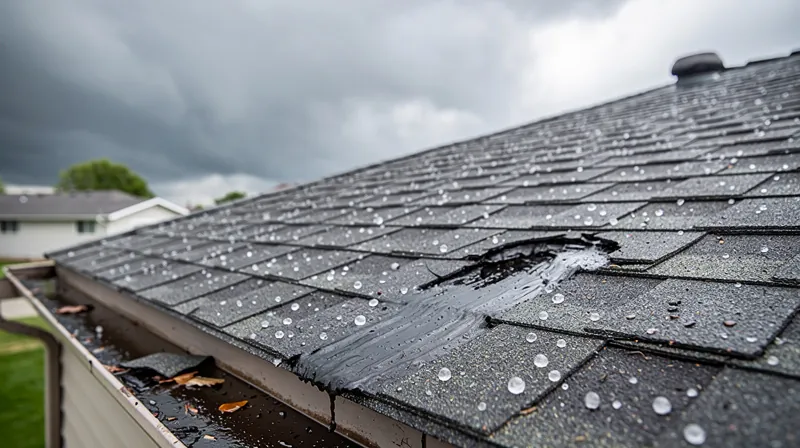
Common perils covered under a standard HO-3 dwelling policy include fire and smoke, lightning strikes, windstorms and hail, explosions, vandalism, falling objects, and damage from the weight of ice and snow. That last one — ice and snow load damage — is frequently overlooked by homeowners in northern climates until a roof collapses under a heavy winter accumulation.
Named-Peril vs. Open-Peril Policies: Why It Matters
The practical difference comes down to the burden of proof during a claim. With a named-peril policy, you must demonstrate that damage was caused by a peril explicitly listed in the contract. With an open-peril policy, the insurer must prove the damage was caused by an excluded event. This distinction can have significant consequences in a disputed claim.
- HO-3: The standard choice for most homeowners. Cost-effective with broad dwelling protection, but narrower personal property coverage.
- HO-5: Higher premiums, but maximum protection across both dwelling and contents. Best suited for high-value homes, custom finishes, or complex structures.
Dwelling Coverage Exclusions and Gaps
Dwelling coverage excludes several common and costly scenarios that homeowners frequently assume are included. Discovering these gaps during a claim — rather than before one — is one of the most financially damaging surprises a homeowner can face.
Standard exclusions across virtually all HO-3 and HO-5 policies include:
- Flood damage: Water entering from outside — storm surge, river overflow, or surface flooding from heavy rain — is universally excluded from standard homeowners policies. A separate flood insurance policy is required.
- Sewer backup and water seepage: Excluded from most standard policies unless a specific endorsement has been added.
- Earthquakes and earth movement: Seismic activity, sinkholes, and landslides are not covered under standard policies.
- Wear and tear: Normal deterioration is treated as a maintenance issue, not an insurable event.
- Pest and rodent damage: Termite damage, for instance, is explicitly excluded across virtually all standard policies.
- Foundation settling: Gradual cracking or settling falls outside coverage scope.
- Mold: Excluded unless it’s a direct result of a separately covered water damage event.
Perils That Require Separate Policies
Several high-impact risk categories require standalone policies or endorsements that sit entirely outside your standard homeowners coverage. Skipping these is a risk many homeowners don’t realize they’re taking until it’s too late.
- Flood Insurance: Available through the federal National Flood Insurance Program (NFIP) or private carriers. Required by mortgage lenders in designated high-risk flood zones. Importantly, 25% of all flood claims come from properties in low-to-moderate risk areas — making this coverage relevant beyond obvious flood zones.
- Earthquake Insurance: Available as a standalone policy or endorsement in most states. Essential for homeowners in California, the Pacific Northwest, and other seismically active regions. Standard deductibles are often 10–20% of the coverage limit.
- Ordinance or Law Coverage: After a major loss, local building codes may require your rebuilt home to meet current standards — at your expense if you lack this endorsement. For older homes with outdated electrical, plumbing, or structural systems, this gap can add tens of thousands of dollars to a rebuild cost.
How to Calculate Your Dwelling Coverage Limits
The correct formula for calculating dwelling coverage is: Square footage × Local rebuild cost per square foot = Estimated Coverage A limit. This is a concrete, repeatable calculation — not a rough guess — and setting it accurately is the most consequential financial decision tied to your homeowners policy.

The most common and costly mistake homeowners make is setting their Coverage A limit to match their home’s purchase price or current Zillow estimate. This is almost always the wrong number. Market value includes land value, neighborhood demand, and economic conditions — none of which factor into the cost of physical reconstruction.
A second critical risk is the coinsurance clause, sometimes called the 80% rule. Most policies require that you insure your home for at least 80% of its full replacement cost. If your home would cost $500,000 to rebuild but you’ve only insured it for $300,000 (60%), your insurer can proportionally reduce the payout on any claim — including partial losses. This penalty is entirely avoidable with an accurate coverage limit.
Step-by-Step Dwelling Coverage Calculation Guide
Here is the exact process to estimate your Coverage A limit — the kind of practical, step-by-step methodology most sources skip or replace with a vague recommendation to “talk to your agent.”
- Measure your home’s finished square footage. Include only livable, finished space. Exclude the lot, driveway, and unfinished basement or attic areas unless they’re part of the structure that would need to be rebuilt.
- Research local rebuild costs per square foot. In 2026, costs vary significantly by region:
- National average: approximately $150–$200 per square foot
- High-cost metros (Los Angeles, San Francisco, New York City): $300–$500+ per square foot
- Florida (hurricane-resilient construction requirements): $200–$350 per square foot
- Midwest and rural markets: $120–$180 per square foot
Reference local construction cost indices such as the Marshall & Swift Residential Cost Handbook, or request a ballpark estimate from a licensed general contractor in your area.
- Multiply and add a contingency buffer. Multiply your square footage by the local cost per square foot, then add 10–20% as an inflation and supply chain buffer. Labor shortages and material price volatility can push actual costs above baseline estimates, particularly following a regional disaster when contractor demand spikes.
- Account for custom features. High-end finishes — custom cabinetry, hardwood flooring, stone countertops, specialty roofing — increase rebuild costs beyond standard estimates. Itemize significant upgrades and adjust your limit accordingly.
- Commission a professional appraisal for high-value homes. If your home has significant custom work, historical architectural details, or a replacement value above $750,000, a certified cost estimator or insurance appraisal will produce a more accurate and defensible figure.
Example: A 2,200 sq ft home in suburban Atlanta with standard finishes at $175/sq ft = $385,000. Adding a 15% inflation buffer brings the recommended Coverage A limit to $442,750.
2026 Rebuild Costs and Inflation Trends
Rebuild costs have increased 30–40% since 2019, driven by pandemic-era lumber price spikes, ongoing supply chain disruptions, a skilled labor shortage in the construction trades, and elevated post-disaster demand. A policy limit that accurately reflected your rebuild cost in 2021 may now cover only 70% of what reconstruction would actually cost — a gap large enough to trigger the coinsurance penalty and leave you with a six-figure shortfall.

In high-risk states, the problem is compounded further. California homeowners face rebuild costs of $300–$500+ per square foot across many markets, with wildfire-driven demand surges frequently leaving local contractors backlogged for months following a major event. Florida homeowners face hurricane-hardened construction requirements that consistently push per-square-foot costs above the national average, compounded by a private insurance market under sustained financial stress that has made securing adequate coverage increasingly difficult in itself.
The most practical solution is an Extended Replacement Cost (ERC) endorsement. This add-on increases your Coverage A payout limit — typically by 20–50% above the stated limit — when actual rebuild costs exceed your policy’s face value. It acts as a direct financial cushion against the inflation-driven underinsurance gap that has become widespread since 2022.
The Inflation Factor: Why Your 2019 Policy Limit Is No Longer Sufficient
A coverage limit set in 2019 is not functionally equivalent to the same dollar figure in 2026 — even if the number on your declarations page hasn’t changed. Inflation erodes your real coverage every year you don’t review and update your limit. Here’s how to stay ahead of it:
- Request an annual replacement cost update. At each renewal, ask your insurer to run an updated replacement cost estimate using current local construction data. Many insurers offer this automatically — confirm it’s active on your policy.
- Verify your inflation guard endorsement. These automatically increase your Coverage A limit each year by a set percentage, typically 4–8%. This is a helpful baseline, but it may not keep pace with localized cost spikes following major regional disasters or sustained market inflation.
- Consider parametric insurance as a supplement. Rather than reimbursing documented losses, parametric policies pay a predetermined amount when a specific triggering event occurs — for example, a Category 4 hurricane making landfall within a defined geographic radius. This structure delivers rapid liquidity after a catastrophe, before the traditional claims and rebuild process concludes. It’s particularly valuable as a complement to standard coverage for homeowners in high-catastrophe-risk zones.
Dwelling Coverage vs. Full Homeowners Insurance: Understanding the Difference
Dwelling coverage (Coverage A) is one component of a homeowners insurance policy — not the policy itself. A complete homeowners insurance package bundles six distinct coverage sections, each addressing a different category of financial risk. Understanding how they fit together is essential for identifying gaps and ensuring you’re not underprotected in areas that scale directly from Coverage A.
| Coverage | What It Protects | Typical Limit |
|---|---|---|
| Coverage A – Dwelling | Physical structure of the home | Based on full rebuild cost |
| Coverage B – Other Structures | Detached structures on the property | 10% of Coverage A |
| Coverage C – Personal Property | Furniture, electronics, clothing, and belongings | 50–70% of Coverage A |
| Coverage D – Loss of Use | Temporary living expenses if home is uninhabitable | 20–30% of Coverage A |
| Coverage E – Personal Liability | Legal liability for injuries or property damage | $100,000–$500,000+ |
| Coverage F – Medical Payments | No-fault medical bills for guests injured on your property | $1,000–$5,000 |
Because Coverages B, C, and D are each calculated as percentages of your Coverage A limit, underinsuring your dwelling automatically underinsures your personal property and loss-of-use protection at the same time. Getting Coverage A right has a cascading effect on the adequacy of your entire policy.
How the Coverage Sections Work Together
Think of your homeowners policy as an interconnected system where Coverage A is the anchor — every other section scales from it.
- Raising Coverage A increases dependent coverages proportionally. Increasing from $300,000 to $400,000 in Coverage A simultaneously raises Coverage B from $30,000 to $40,000, personal property coverage from $150,000–$210,000 to $200,000–$280,000, and loss-of-use coverage from $60,000–$90,000 to $80,000–$120,000.
- Coverage E (Liability) is independent and warrants separate evaluation. Standard limits of $100,000 are frequently insufficient for homeowners with significant assets, savings, or income. Consider a $300,000–$500,000 limit, or supplement with a personal umbrella policy for broader net-worth protection.
- Verify that Coverage D is adequate for a realistic rebuild timeline. Major rebuilds in 2026 commonly take 12–24 months. Confirm that your loss-of-use limit is sufficient to cover that duration at actual local rental rates — not just a few months of hotel costs.
Frequently Asked Questions About Dwelling Coverage
What should the dwelling coverage be on homeowners insurance?
Your dwelling coverage limit should equal the full estimated cost to rebuild your home from the ground up at current local construction prices — not your home’s market value or purchase price. Calculate this by multiplying your home’s square footage by local rebuild costs per square foot (typically $150–$500+ depending on location in 2026), then adding a 10–20% buffer for inflation and contingencies. Review and update this figure annually to stay ahead of rising construction costs.
How do you calculate the coverage needed for a dwelling?
Use this formula: Square footage × Local rebuild cost per square foot = Estimated Coverage A limit. For example, a 2,000 sq ft home in a market with $200/sq ft rebuild costs requires approximately $400,000 in Coverage A, plus a 10–20% inflation buffer. For homes with custom finishes, high-end materials, or values above $750,000, a professional appraisal will provide a more accurate and defensible estimate than a self-calculation alone.
What is not covered by dwelling coverage?
Dwelling coverage does not cover flood damage, earthquake damage, sewer backups, pest infestations, normal wear and tear, mold (unless directly caused by a covered water event), or gradual structural settling. These exclusions are standard across virtually all HO-3 and HO-5 policies. Floods and earthquakes require completely separate policies, while sewer backup and ordinance or law coverage can typically be added as endorsements to your existing policy.
How much dwelling coverage should I carry?
Carry enough dwelling coverage to fully rebuild your home at current construction costs — a figure that ranges from approximately $150 to $500+ per square foot in 2026, depending on your location and home’s specifications. Your limit should never fall below 80% of the true rebuild cost, or you risk triggering the coinsurance clause and receiving a proportionally reduced payout on any claim. Most insurance professionals recommend insuring to 100% of rebuild cost and adding an Extended Replacement Cost endorsement as an additional buffer against inflation.
Does dwelling coverage cover a garage?
Yes — if the garage is physically attached to your home, it falls under Coverage A and is protected under the same limit as the main structure. If the garage is detached and separated from the main house, even by a small physical gap, it falls under Coverage B (Other Structures), which is typically capped at 10% of your Coverage A limit. If your detached garage has significant value, verify that your Coverage B limit is sufficient to cover a full rebuild independently.
What is the difference between actual cash value and replacement cost?
Replacement Cost Value (RCV) pays to repair or rebuild your home with new, like-kind materials at current prices without applying depreciation, while Actual Cash Value (ACV) pays only the depreciated worth of the damaged structure at the time of the loss. In practical terms, a 20-year-old roof under an ACV policy might pay out only 20–30% of the cost of a new roof, leaving you responsible for the difference. For primary residences, replacement cost coverage is strongly recommended because ACV payouts routinely fall far short of actual repair costs.
How do I avoid the coinsurance penalty?
Avoid the coinsurance penalty by ensuring your Coverage A limit equals at least 80% — and ideally 100% — of your home’s current estimated rebuild cost. Calculate your rebuild cost using current local construction rates rather than market value, add a 10–20% inflation buffer, and consider adding an Extended Replacement Cost endorsement that increases your payout limit by 20–50% if actual costs exceed your stated limit. Review your coverage limit every 12 months, and any time you make significant home improvements.
Is dwelling coverage the same as homeowners insurance?
No — dwelling coverage (Coverage A) is one component of a homeowners insurance policy, not the complete policy. A full homeowners policy also includes Coverage B (Other Structures), Coverage C (Personal Property), Coverage D (Loss of Use), Coverage E (Personal Liability), and Coverage F (Medical Payments). Dwelling coverage specifically protects your home’s physical structure; the remaining coverages address your personal belongings, legal liability exposure, and temporary living costs during a rebuild.
Should I add Extended Replacement Cost to my policy?
Yes — Extended Replacement Cost (ERC) is one of the most valuable endorsements available to homeowners and is especially critical given current construction cost inflation. ERC increases your Coverage A payout by 20–50% above your stated limit if actual rebuild costs exceed the amount you’ve insured for — providing a direct financial cushion against the underinsurance gap that affects millions of homeowners when local construction prices spike after a major disaster. Given that rebuild costs have risen 30–40% since 2019, this endorsement is no longer optional for risk-conscious homeowners in any market.