
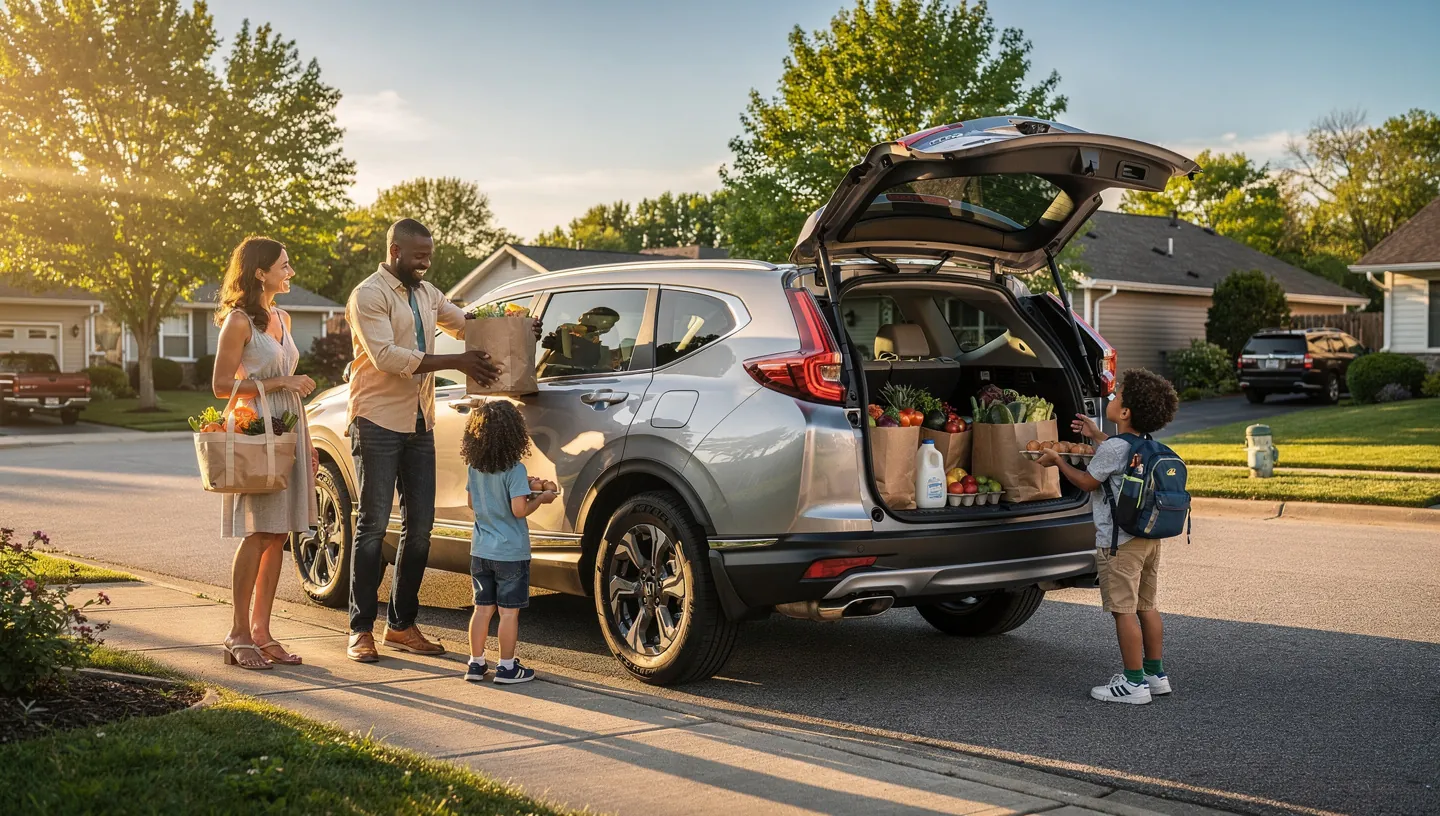
The rules of car insurance have been rewritten. A decade ago, a smaller engine and an older model almost guaranteed lower premiums. Today, insurers are laser-focused on two metrics that have nothing to do with engine displacement: vehicle safety ratings and repair costs. The result is a counterintuitive reality where a modern compact SUV can be dramatically cheaper to insure than the aging economy sedan sitting in your neighbor’s driveway.
The Honda CR-V currently holds the title for lowest annual premiums, averaging between $1,932 and $2,316 for full coverage depending on your coverage level and location. It is not alone. A cluster of compact SUVs and crossovers has overtaken traditional sedans at the top of the affordability rankings, driven by superior crash-test scores and predictable repair bills that insurers love.
But here is the detail most guides skip: the cheapest car to insure nationally may cost you 85% more in certain states. A Honda CR-V runs about $1,720 annually in Indiana and balloons to $3,187 in Louisiana — same vehicle, radically different bill. Your driving history and credit score can erase every dollar saved by choosing the “right” car. This guide cuts through the noise with the granular data you actually need to make a smart decision.
Key Takeaways
- The Honda CR-V and Honda HR-V are the most affordable vehicles to insure, both averaging around $1,932 annually for full coverage.
- Compact SUVs like the Subaru Forester and Mazda CX-5 dominate the cheapest-to-insure rankings, thanks to strong safety features and moderate repair expenses.
- Insurance premiums for the cheapest cars range from approximately $1,400 to $2,400 annually, significantly below the national average for full coverage.
- Regional factors — including accident rates and local repair shop availability — can cause the same vehicle to cost up to 85% more in one state versus another.
- Liability-only coverage is dramatically cheaper than full coverage, but full coverage is typically required for financed or newer vehicles and provides essential financial protection.
The Top 10 Cheapest Cars to Insure in 2026

The cheapest cars to insure in 2026 are overwhelmingly compact SUVs and crossovers. Leading the pack is the Honda CR-V at $1,932–$2,316 annually, followed closely by the Honda HR-V, Mazda CX-5, and Subaru Forester — all of which carry IIHS Top Safety Pick ratings that translate directly into lower collision claims and reduced liability exposure for insurers.
| Vehicle | Est. Annual Premium (Full Coverage) | Key Insurance Advantage |
|---|---|---|
| Honda CR-V | $1,932 – $2,316 | Top safety ratings, low repair costs |
| Honda HR-V | ~$1,932 | Compact size, ADAS standard features |
| Subaru Forester | $367 – $2,013* | IIHS Top Safety Pick+, EyeSight standard |
| Mazda CX-5 | $364 – $2,021* | Strong crash-test scores, durable build |
| Volkswagen Tiguan | ~$2,050 – $2,100 | Competitive parts pricing |
| Hyundai Kona | ~$2,050 – $2,100 | Low MSRP reduces comprehensive exposure |
| Toyota RAV4 | $2,000 – $2,300† | Wide repair network, strong resale |
| Subaru Outback | $2,000 – $2,350† | Reliable safety systems |
| Hyundai Venue | from ~$1,176 (select states) | Low MSRP, minimal theft profile |
| Toyota Tacoma | $1,900 – $2,200 | Cheapest pickup truck option nationally |
*Lower bound reflects liability-only estimates in favorable states. †Varies significantly by trim level and geography.
The Honda CR-V: A Dual Leader
The Honda CR-V ranks #1 across multiple independent data sources — including Insurance.com and CarInsurance.com — making it the most consistently affordable vehicle to insure in America. That consensus is not accidental. It is the product of a deliberate engineering profile that insurers treat as low-risk by almost every measurable standard.
- Standard safety technology: Every CR-V trim includes Honda Sensing, a suite that bundles automatic emergency braking (AEB), lane-departure warning, adaptive cruise control, and lane-keep assist. Each of these systems has a documented, actuarial-level impact on reducing collision claims.
- Repair cost predictability: Honda’s parts are widely available, and the CR-V’s structure avoids the exotic aluminum panels or proprietary components that inflate repair bills on European competitors.
- Low theft profile: Modern CR-Vs are significantly less targeted by vehicle thieves than older models, reducing comprehensive claim frequency.
The annual premium range of $1,932 to $2,316 reflects the spread between a liability-forward policy in a low-risk state versus full coverage in a moderately urban environment. Your actual rate will land somewhere in that range — or outside it entirely if you live in Louisiana or Michigan.
Runner-Up: Compact SUVs and Crossovers
The broader compact SUV segment shares the CR-V’s advantages at a systemic level. The Subaru Forester and Mazda CX-5 both carry IIHS Top Safety Pick designations and come equipped with standard ADAS packages, making them structurally attractive to underwriters. Their annual premiums sit in the $2,000–$2,021 range for full coverage in most markets.
What makes this segment particularly compelling is the combination of factors working in the driver’s favor simultaneously:
- Above-average occupant protection reduces bodily injury liability payouts
- Moderate vehicle MSRP keeps comprehensive coverage costs contained
- High parts availability in most markets suppresses repair labor costs
- Strong resale values reduce the insurer’s total-loss exposure
The conventional wisdom that smaller always means cheaper to insure is wrong. A Honda Civic or Toyota Camry — both traditional “economy” choices — frequently generate higher annual premiums than a Forester or CX-5, precisely because they lack the newer safety technology and produce higher per-claim repair costs relative to their value.
Why SUVs and Crossovers Are Cheaper Than Sedans

Modern compact SUVs are cheaper to insure than comparable sedans because they earn better safety ratings, generate lower injury claims, and carry predictable repair costs — three factors that directly drive insurer risk models. This is a structural shift in how the industry prices vehicle type, and it fundamentally changes which cars belong in a cost-conscious buyer’s consideration set.
For years, the industry defaulted to a simple heuristic: smaller car, smaller premium. That model collapsed as crash-test methodologies became more rigorous and ADAS technology became widespread on SUVs first. Today, a Subaru Forester with standard EyeSight technology will consistently undercut a comparable-vintage Honda Civic on insurance premiums — even though the Civic is lighter, slower, and ostensibly “safer” under the old framework.
The Role of Advanced Safety Features
Advanced Driver Assistance Systems (ADAS) — including automatic emergency braking, lane-keep assist, and blind-spot monitoring — have a direct, quantifiable effect on insurance premiums. The Highway Loss Data Institute (HLDI) has documented that AEB alone reduces rear-end collision claims by up to 50% in some vehicle categories. Insurers price this reduction into the policy.
The vehicles on the cheapest-to-insure list share a common thread: ADAS features are standard equipment, not optional add-ons. This matters because insurers rate the vehicle as built, not as optioned. A base-trim Honda CR-V with Honda Sensing receives the same actuarial credit as a fully-loaded model — delivering maximum safety discount at minimum cost.
- Automatic Emergency Braking (AEB): Reduces front-to-rear crash frequency and severity
- Lane Departure Warning: Lowers single-vehicle run-off-road claims
- Adaptive Cruise Control: Reduces highway-speed following-distance incidents
Repair Costs and Parts Availability
Lower insurance premiums are not just about the probability of an accident — they reflect the cost to fix the vehicle when one does occur. A BMW M-series with carbon fiber body panels and proprietary electronics can generate a $12,000 repair bill from an incident that would cost $2,800 on a Honda CR-V. Insurers build that delta directly into the premium.
The Honda CR-V and Subaru Forester both benefit from broad parts networks. Honda components are stocked at thousands of independent repair shops nationwide, eliminating the dealership-exclusive markup that inflates collision repair costs for European and luxury brands. Subaru’s EyeSight cameras, while sophisticated, are designed for straightforward recalibration after windshield replacement — a common pain point on vehicles with more proprietary sensor installations.
Contrast this with luxury compact SUVs in the same size class: a Mercedes-Benz GLC or BMW X3 can cost 40–60% more to insure than a CR-V of comparable age, driven almost entirely by parts cost and labor rate differentials — not by meaningful differences in accident frequency.
Liability vs. Full Coverage: The Cost Breakdown

Liability-only coverage pays for damage and injuries you cause to others; full coverage adds collision (damage to your own vehicle) and comprehensive (theft, weather, non-collision events). For a Honda CR-V, moving from a liability-only policy to full coverage can push annual costs from roughly $1,400 to over $2,300 — a difference of nearly $900 per year that most comparison guides fail to make explicit.
This is one of the most significant gaps in competing content: lists routinely publish the lowest available rate for a vehicle without specifying that the figure reflects liability-only coverage at state minimums in a favorable location. That number is real, but it is not the rate most drivers will pay — and it leaves them substantially underprotected.
Understanding Your Coverage Limits
A complete full-coverage auto policy contains four primary components, each carrying its own cost and function:
- Bodily Injury Liability (BI): Pays for injuries to other people when you are at fault. State minimums are often dangerously low ($25,000 per person in many states).
- Property Damage Liability (PD): Covers damage to other vehicles or property in an at-fault accident.
- Collision Coverage: Pays to repair or replace your vehicle after an accident, regardless of fault. Subject to your chosen deductible.
- Comprehensive Coverage: Covers non-collision losses — theft, hail, flood, fire, animal strikes. Also subject to a deductible.
Deductibles are a powerful lever. Raising your collision and comprehensive deductible from $500 to $1,000 typically reduces full-coverage premiums by 10–15%, depending on the insurer and vehicle. For a CR-V at $2,316 annually, that adjustment could save $230–$347 per year — meaningful savings if you have the liquidity to cover the higher deductible in a claim scenario.
When Liability Isn’t Enough
If your vehicle is financed or leased, your lender requires full coverage — this is non-negotiable and written into your loan agreement. Carrying only liability on a financed vehicle creates a catastrophic financial gap: if your car is totaled, you owe the remaining loan balance with no insurance payout to cover it.
Even for paid-off vehicles, liability-only coverage carries hidden risks that compound quickly:
- An at-fault accident in a state with high liability minimums can exceed your coverage limits, exposing personal assets to judgment
- An uninsured or underinsured motorist can leave you holding full repair costs with no recourse
- A single hail event or vehicle theft creates a total loss on a vehicle you thought was safely covered
The reality is that even the cheapest cars to insure can generate devastating out-of-pocket costs without adequate coverage. The Honda CR-V’s low premium advantage is best captured with a well-structured full-coverage policy — not by stripping coverage to the state minimum.
State-by-State Variance: Location Matters

The phrase “cheapest car to insure” is meaningless without a geographic qualifier. The same Honda CR-V costs $1,720 per year in Indiana and $3,187 in Louisiana — an 85% difference for identical iron. Your zip code is one of the single most powerful variables in your premium calculation, often outweighing the vehicle selection itself.
National averages serve as useful benchmarks, but they should never be used as budgeting tools without first checking state-level data. A driver in Maine or Massachusetts shopping for a Hyundai Venue may find premiums starting around $1,176 annually. That same driver relocating to Florida or Louisiana will face premiums more than double that figure on the identical vehicle with the identical driving record.
Regional Risk Factors
State-level premium differences are driven by a combination of structural and environmental factors that insurers model with granular precision:
- Weather exposure: Gulf Coast states face elevated comprehensive rates due to hurricane and flooding risk. Hail corridors in Texas and Oklahoma drive comprehensive claim frequency. These costs are priced into every policy in the affected region, regardless of the vehicle.
- Traffic density and accident rates: Urban markets in California, New York, and Florida have significantly higher collision claim frequency than rural Midwestern states. Higher claim frequency means higher liability coverage costs for everyone in the pool.
- Legal environment: No-fault states (Michigan, Florida, New York) require Personal Injury Protection (PIP) coverage that adds meaningfully to base premiums. Michigan’s historically extreme rates stem from a unique no-fault system that only recently underwent reform.
- Theft prevalence: Urban markets with high vehicle theft rates generate elevated comprehensive claims. The theft rates for specific models vary by city, meaning a Hyundai Kona in Chicago may carry different comprehensive pricing than the same vehicle in Des Moines.
Navigating High-Risk States
If you live in a high-cost state, your vehicle selection still matters — but the premium reduction from choosing a CR-V over a Camry is compressed relative to a low-cost state. Strategies that genuinely move the needle in high-cost markets include:
- Bundling home and auto insurance: Multi-policy discounts of 10–25% are common and apply regardless of state
- Increasing deductibles: In high-rate states, the percentage savings from a higher deductible can represent larger absolute dollar amounts
- Shopping aggressively: Rate variance between insurers is wider in high-cost states — GEICO, Nationwide, and regional carriers can differ by $600–$1,200 annually for the same risk profile
- Telematics programs: Usage-based insurance programs reward low-mileage and safe-driving behavior with discounts that partially counteract geographic penalties
Personal Factors: The Driver Profile

Your car is only half the equation. Your driving history, credit score, age, and marital status can collectively move your premium by hundreds — or thousands — of dollars annually, independent of what vehicle you choose. Buying the cheapest car to insure will not save you money if your personal risk profile flags you as a high-cost driver.
This is the dimension most comparison guides ignore entirely. They present the Honda CR-V’s $1,932 average as if it applies uniformly — but a 19-year-old driver with one at-fault accident and a thin credit file may pay $4,500 or more for the exact same vehicle. Understanding how insurers weigh your driver profile is as important as understanding which vehicles carry favorable base rates.
The Impact of Driving History
Your driver history is the most immediate and powerful modifier applied to your base vehicle rate. A single at-fault accident typically increases premiums by 30–50% for three to five years, depending on the insurer and state. A DUI conviction can double or triple premiums and remain on your record for a decade in many states.
- At-fault accidents: Surcharges typically persist for 3–5 years and compound with subsequent violations
- Speeding tickets: Even a single citation can increase premiums 15–30% at renewal
- DUI/DWI convictions: Often trigger SR-22 requirements and premium surcharges of 70–150%
- Clean record discount: Restoring a “good driver” designation typically requires 3–5 consecutive violation-free years
A poor driving record can fully negate the savings of a cheap car. A driver with two at-fault accidents paying $3,800 annually on a Honda CR-V is paying more than a clean-record driver pays on a Toyota RAV4 Hybrid. Vehicle selection matters, but behavioral history matters more.
Age and Demographics
Age is among the most heavily weighted variables in insurance premiums. Teen drivers (16–19) represent the highest-risk demographic actuarially, and their premiums reflect it — often 150–250% above adult baseline rates. Adding a teen to a family policy with a Honda CR-V will increase total premiums substantially, but the CR-V remains the most cost-effective vehicle choice within that high-risk bracket.
Other demographic factors that influence pricing:
- Marital status: Married drivers statistically generate fewer claims; most insurers apply a modest discount relative to single drivers with identical records
- Senior drivers (70+): Some insurers apply surcharges due to actuarial data on reaction-time-related incident rates, though this varies significantly by carrier
- Annual mileage: Lower annual mileage correlates with lower claim frequency — commuting patterns directly affect rate calculations
Credit score is a legally permitted rating factor in 47 states. Insurers have documented a statistically significant correlation between credit history and claim frequency. A driver with poor credit can pay 50–100% more than an identical driver with excellent credit on the same vehicle. Building credit is, functionally, an insurance cost reduction strategy in most of the country.
How to Find the Best Rate for Your Specific Car
Finding the lowest possible premium on a cheap-to-insure vehicle requires active comparison — not just selecting the right car. The rate variance between insurers for the same driver and vehicle can exceed $1,000 annually, and that gap does not narrow just because you chose a Honda CR-V.
Follow this structured approach to minimize your annual premiums:
- Get at least 3–5 quotes before binding any policy. Nationwide and GEICO consistently appear among the most competitive carriers for compact SUVs with clean driving records. State Farm and Progressive offer strong rates for high-mileage drivers. Regional carriers often undercut national brands in specific states.
- Bundle home and auto insurance. Multi-policy discounts of 10–25% are among the most reliable savings mechanisms available, and they apply regardless of which vehicle you drive.
- Use online comparison platforms (The Zebra, NerdWallet, Insurify) for rapid multi-carrier quotes, then follow up directly with the top 2–3 carriers for precise binding quotes.
- Optimize your deductible structure. If you have $1,000 in accessible savings, consider raising your deductible to $1,000 and capturing the resulting premium reduction.
- Enroll in telematics. Programs like GEICO DriveEasy, Progressive Snapshot, and Nationwide SmartRide reward safe driving behavior with meaningful discounts — particularly valuable for young drivers trying to offset age surcharges.
- Review your policy annually. Life changes (improved credit, accident expiration, relocation) that reduce your risk profile should trigger a fresh round of quotes.
Remember: the nationally cheapest car to insure may not be the cheapest car to insure for you. A 22-year-old driver with a clean record living in rural Ohio may find the CR-V’s premium advantage fully intact. That same driver living in Miami with a speeding ticket will find that personal factors have overridden the vehicle’s favorable base rate. Local data and carrier-specific quotes are the only way to know your actual number.
Frequently Asked Questions
What type of car is cheapest to insure?
Compact SUVs and crossovers are the cheapest vehicle type to insure in 2026. Models like the Honda CR-V, Honda HR-V, Subaru Forester, and Mazda CX-5 consistently generate the lowest annual premiums due to high safety ratings, standard ADAS technology, and moderate repair costs. This represents a significant shift from historical norms, where small sedans were assumed to be the most affordable option.
Is it cheaper to insure a Honda CR-V?
Yes — the Honda CR-V is consistently ranked as the cheapest or joint-cheapest vehicle to insure in the United States, averaging $1,932–$2,316 annually for full coverage. Its standard Honda Sensing safety suite, broad parts availability, and low theft profile make it structurally attractive to insurers across multiple carriers. However, individual rates depend heavily on your location, driving history, and credit score.
Why are SUVs cheaper to insure than sedans?
Modern compact SUVs earn lower insurance premiums than comparable sedans because they carry superior safety ratings and generate lower injury-related claims. Insurers have found that ADAS features — which became standard on SUVs before sedans — meaningfully reduce collision claim frequency and severity. Additionally, high-volume repair networks for popular SUVs keep parts and labor costs competitive, further reducing the insurer’s expected payout per claim.
How much can I save by switching to a cheaper car?
Switching from a high-premium vehicle to a Honda CR-V or comparable compact SUV can save $500–$1,500 annually depending on your current vehicle and location. The savings are most pronounced when moving from a luxury vehicle, sports car, or older sedan with high repair costs. Your driving history and credit score will determine how much of the vehicle’s favorable base rate you actually capture.
What is the difference between liability and full coverage?
Liability coverage pays for injuries and property damage you cause to others; full coverage adds collision (your own vehicle after an accident) and comprehensive (theft, weather, and other non-collision events). For a Honda CR-V, the difference between a liability-only policy and full coverage can be $700–$900 or more per year. Full coverage is typically required by lenders on financed vehicles and provides essential protection against total-loss scenarios.
Do insurance rates vary by state?
Yes — insurance rates for the same vehicle can vary by 85% or more between states. A Honda CR-V costs roughly $1,720 annually in Indiana and $3,187 in Louisiana under similar coverage structures. These differences are driven by accident claim frequency, weather-related comprehensive claims, state legal environments (including no-fault laws), and local repair costs.
Does my credit score affect my insurance rates?
In 47 states, insurers are legally permitted to use credit-based insurance scores as a rating factor — and they do so extensively. Drivers with poor credit can pay 50–100% more than drivers with excellent credit on the same vehicle and coverage levels. Improving your credit score is one of the most effective long-term strategies for reducing insurance premiums, independent of which vehicle you drive.
What is the cheapest car for a 16-year-old to insure?
The Honda CR-V and Honda HR-V are the most affordable options for teen drivers, though premiums for this age group are universally elevated — often 150–250% above adult rates. Teen drivers benefit from the same vehicle-level safety discounts that apply to all drivers, making the CR-V the lowest-cost starting point within an inherently expensive demographic bracket. Adding a teen to a family policy with bundling discounts is typically more affordable than a standalone teen policy on any vehicle.